







Software
Cost of Software Development in 2026 | Ultimate Guide to Custom Software Pricing


roshan adhikari
22 May 2026
How Much Does Software Development Cost in 2026? | Ultimate Guide
Software development costs are influenced by project complexity, technology stack, team composition, and ongoing maintenance requirements.
In addition, regional labor rates, platform choice, and the adoption of emerging technologies such as AI, cloud computing, and blockchain can significantly impact the overall budget.
This AITC International comprehensive guide provides key cost drivers, regional pricing variations, and actionable strategies to optimize your software development investment. Whether you are a startup, SME, or enterprise, this blog guides you to make informed decisions and achieve maximum ROI from your software projects.
Cost of Software Development
The cost of software development ranges from $10,000 to $1,000,000, depending on project type, technology stack, and team structure. Key cost drivers include software complexity, UX/UI design, third-party integrations, and maintenance, while outsourcing and Agile practices can help optimize budgets.
| Region | Hourly Rate | Project Cost Range |
| USA / Canada | $75–$200/hr | $50,000–$500,000+ |
| Western Europe | $50–$150/hr | $40,000–$300,000 |
| Eastern Europe | $25–$70/hr | $20,000–$150,000 |
| India / Asia | $15–$50/hr | $10,000–$100,000 |
Choosing a region involves balancing budget, expertise, time zones, and language alignment.
Key Factors That Influence Software Development Cost
The total cost of custom software development depends on multiple interrelated factors. Understanding these variables is essential for accurate budgeting and informed decision-making.
1. Type of Software
The nature and complexity of the software significantly affect development costs:
- Mobile Applications: Simple mobile apps can start around $10,000, while feature-rich or enterprise-grade apps can exceed $250,000, depending on integrations, APIs, and platform requirements.
- Web Applications: Costs range from $20,000 to $300,000, influenced by complexity, third-party integrations, and scalability demands.
- Enterprise Software: Large-scale systems typically cost $50,000–$1,000,000+, reflecting intricate workflows, high-security requirements, and robust scalability.
- SaaS Platforms: Multi-tenant applications with cloud infrastructure and advanced functionality generally fall within $50,000–$500,000+.
2. Development Team Structure
The composition and expertise of your development team directly influence costs:
- Freelancers: Typically charge $15–$80/hour, ideal for MVPs or small-scale projects with limited complexity.
- In-House Teams: Average $50–$150/hour, accounting for salaries, office infrastructure, and employee benefits
- Outsourced Companies: Rates vary from $25–$200/hour, depending on geographic location, team expertise, and project complexity.
3. Technology Stack
The technologies and frameworks chosen impact both development time and cost:
- Advanced technologies such as AI, blockchain, IoT, or AR/VR increase project budgets due to specialized expertise and longer development cycles.
- Modern frameworks like React, Angular, Node.js, Python, or Java also influence hourly rates and system scalability.
4. UX/UI Design and User Experience
User interface and experience are critical for adoption and engagement:
- Custom designs can add $5,000–$50,000+, depending on complexity and user research requirements.
- Enterprise systems with multiple workflows demand extensive UX research, wireframing, and prototyping to ensure usability and efficiency.
5. Maintenance and Updates
Ongoing support and system updates are crucial for long-term performance and security:
- Maintenance typically costs 15–20% of the initial development budget annually.
- This includes bug fixes, feature upgrades, cloud hosting, performance monitoring, and compliance updates.
By evaluating these factors early in the planning phase, businesses can accurately forecast software development costs, allocate resources effectively, and avoid budget overruns, ensuring a high ROI on their technology investment.
Software Development Hidden Costs to Keep in Mind
While the primary development budget covers core features and functionality, several hidden costs can significantly impact the total software investment. Being aware of these factors helps businesses plan more accurately and avoid unexpected expenses.
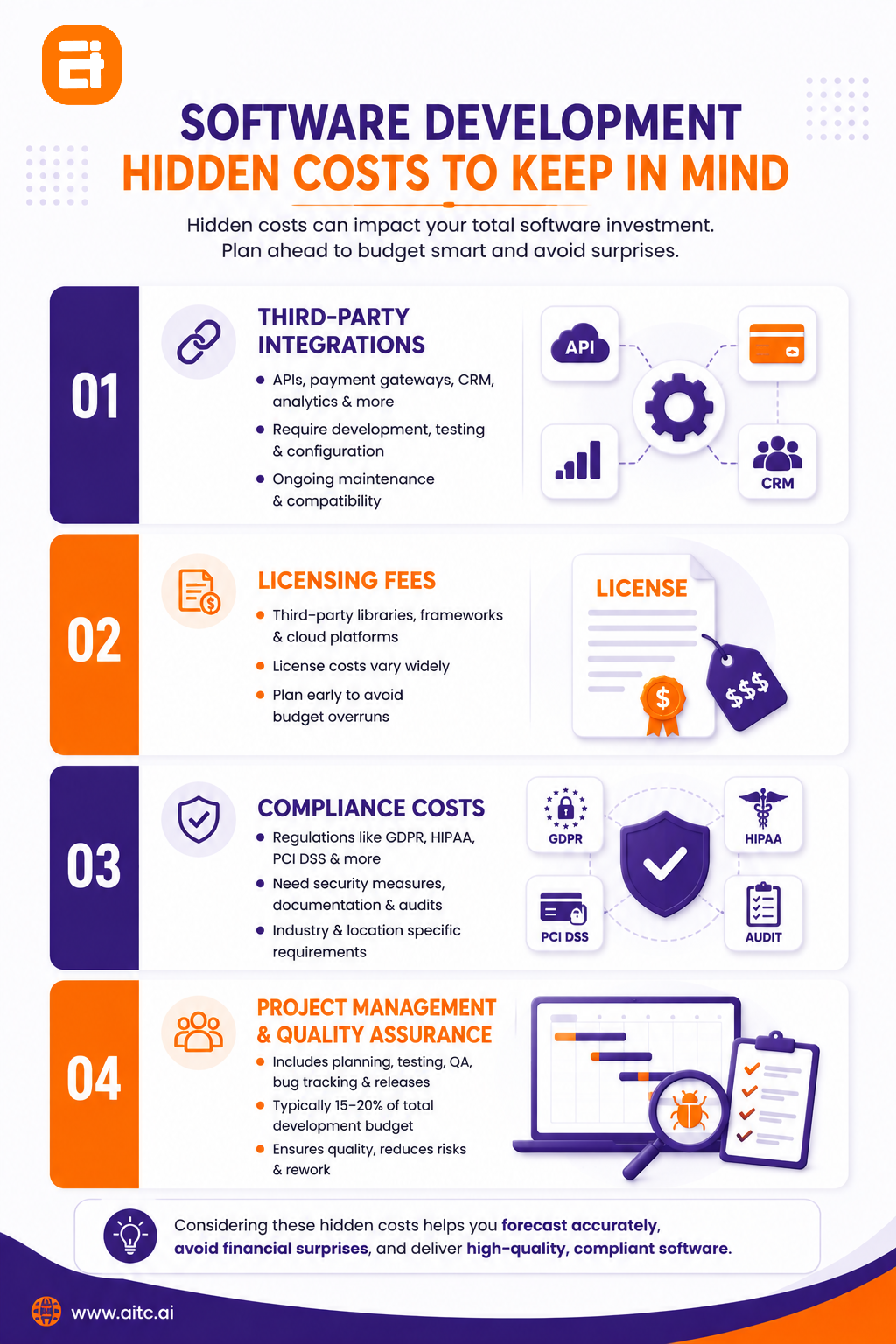
1. Third-Party Integrations
Integrating external services—such as payment gateways, APIs, analytics tools, CRM systems, and marketing platforms—can increase development complexity and cost. Each integration requires testing, configuration, and ongoing maintenance to ensure reliability and compatibility.
2. Licensing Fees
Many software projects rely on third-party libraries, frameworks, and cloud platforms. Licensing fees for these technologies can vary widely, especially for enterprise-scale applications or commercial packages. Accounting for these costs early prevents budget overruns.
3. Compliance Costs
Depending on the industry and geographic location, compliance requirements can add substantial costs. Regulations such as GDPR, HIPAA, PCI DSS, or other sector-specific standards require additional development effort, security measures, and ongoing audits to remain compliant.
4. Project Management & Quality Assurance
Effective project management, QA testing, and quality control are critical to delivering a reliable product. These processes typically account for 15–20% of the total development budget and include sprint planning, testing cycles, bug tracking, and release management.
By proactively considering these hidden costs, businesses can forecast budgets more accurately, minimize financial surprises, and ensure smooth project execution while maintaining high-quality, compliant software.
Strategies to Optimize Software Development Costs
Effectively managing software development costs requires strategic planning and process optimization. Implementing the right approaches ensures high-quality delivery while maximizing ROI.
1. Define a Clear Scope
Establishing a well-defined project scope at the outset prevents over-engineering and scope creep. Focus on developing a Minimum Viable Product (MVP) with essential features first, allowing you to validate ideas, gather user feedback, and iterate efficiently before investing in advanced functionality.
2. Use Agile Methodologies
Adopting Agile development practices improves project efficiency and reduces wasted effort. Iterative development, continuous feedback, and frequent testing help teams prioritize high-value features, identify issues early, and deliver software on time and within budget.
3. Outsource Strategically
Combining in-house teams with offshore or nearshore talent can significantly reduce costs while maintaining quality. Outsourcing specialized tasks or scaling development teams based on project needs enables flexible resource allocation and access to global expertise without long-term overheads.
4. Leverage Open-Source Tools
Utilizing open-source frameworks, libraries, and platforms can lower licensing costs, accelerate development, and reduce dependency on proprietary solutions. Open-source tools also benefit from community support and frequent updates, enhancing both security and functionality.
5. Plan for Scalability
Designing a modular, cloud-ready architecture from the start prevents costly redesigns later. Scalable systems can accommodate growing user bases, increasing data volumes, and evolving business requirements without requiring complete redevelopment.
By applying these strategies, businesses can optimize development budgets, reduce operational risks, and ensure high-quality, scalable software that delivers long-term value.
Choosing the Right Software Development Partner
Selecting the right software development partner is critical for controlling costs while ensuring quality, scalability, and long-term success. The ideal partner combines technical expertise, industry experience, and a strategic approach to delivering solutions that align with business objectives.
When evaluating potential partners, consider companies with proven capabilities in:
- Custom Software Development – Tailored solutions that address specific business workflows and operational needs.
- SaaS and Cloud Platforms – Scalable, multi-tenant solutions optimized for performance and reliability.
- AI-Driven Applications – Intelligent systems that leverage data for automation, predictive analytics, and decision support.
- Enterprise Systems – Robust ERP, CRM, and workflow automation platforms designed for complex organizations.
Top-performing companies, including AITC International, ScienceSoft, ELEKS, and BairesDev, have a track record of delivering high-performance, secure, and scalable software. By choosing such partners, organizations can achieve digital transformation efficiently, optimize development costs, and maintain predictable budgets without compromising on innovation or system quality.
Conclusion
The cost of software development in 2026 varies widely based on factors such as project complexity, technology stack, team composition, and geographic region. While simple mobile applications may start at $10,000, enterprise-grade systems can exceed $1,000,000. Additionally, hidden costs, including third-party integrations, licensing fees, compliance requirements, and ongoing maintenance, can significantly impact the overall budget.
Businesses can optimize software development expenses by defining a clear project scope, focusing on MVP, adopting Agile methodologies, leveraging open-source tools, and strategically selecting the right development partner.
Leading firms such as AITC International, ScienceSoft, ELEKS, and BairesDev specialize in delivering custom, scalable, AI-driven, and enterprise-ready software solutions that provide measurable business value while keeping costs manageable.
Investing in the right software partner ensures long-term scalability, enhanced operational efficiency, and a sustainable competitive advantage in the rapidly evolving digital landscape.
Frequently Asked Questions (FAQs)
1. How much does custom software development cost?
Simple applications cost $10,000, while enterprise-grade solutions can exceed $1,000,000. Custom software development costs vary widely depending on project type, complexity, features, team structure, and technology stack.
2. What factors influence software development costs?
Key factors include:
- Project Type: Mobile apps, web apps, SaaS platforms, enterprise systems
- Technology Stack: AI, blockchain, cloud, microservices, AR/VR
- Team Structure: Freelancers, in-house teams, or outsourced development companies
- UX/UI Design and User Experience: Custom interfaces, multiple workflows
- Maintenance and Updates: Post-launch support, bug fixes, cloud hosting
- Third-Party Integrations & Licensing: APIs, analytics, frameworks, and libraries
3. How does the region affect software development costs?
Hourly rates differ significantly by region:
- USA & Canada: $75–$200/hour
- Western Europe: $50–$150/hour
- Eastern Europe: $25–$70/hour
- India / Asia: $15–$50/hour
Choosing a region balances budget constraints, technical expertise, and delivery speed.
4. How can I reduce software development costs?
Cost optimization strategies include:
- Defining a clear project scope
- Starting with a Minimum Viable Product (MVP)
- Adopting Agile development practices
- Outsourcing strategically or combining in-house and offshore teams
- Leveraging open-source tools and frameworks
5. Are there hidden costs in software development?
Yes. Hidden costs may include:
- Licensing fees for software libraries or cloud platforms
- Third-party API or service integrations
- Regulatory compliance (e.g., GDPR, HIPAA, PCI DSS)
- Ongoing maintenance, bug fixes, and cloud hosting
- Project management, QA, and quality control expenses
6. Which companies provide cost-effective, high-quality custom software solutions?
Top global software development firms include: AITC International, ScienceSoft, ELEKS, BairesDev, Simform, Intellectsoft, and Netguru. These companies deliver scalable, enterprise-ready, and AI-driven solutions while helping businesses optimize costs and maximize ROI.

Related insights
-in-Business_1763716856557-585605410_2025-11-21.png&w=3840&q=75)
The Rise of Virtual and Augmented Reality (VR/AR) in Business
21 Nov 2025

Choosing the Right E-Commerce Platform for Your Nepal-Based Business
21 Nov 2025

The Evolution of Software Development: A Journey Through Time
19 Dec 2025
Have a project in mind? Let's build something great.
Share your ideas or questions and our experts will get back to you shortly.
Unlock Expert Guidance
Need expert IT advice? Our seasoned professionals are here to help you navigate your tech challenges. Schedule a session with us and get personalized solutions tailored to your business needs.

Connect with Us and Let's Build Something Together
We'd love to hear from you! Whether you have questions, need support, or want to discuss a new project, our team is ready to assist. Fill out the form below, and we’ll get back to you as soon as possible.
Prefer a Direct Consultation?
Connect with our team for a 1-on-1 virtual session to discuss your project, understand your needs, and explore the right solution for your business.
What's Next?
- 1Connect with you at a convenient time
- 2Explore your needs, goals, and requirements
- 3Prepare a tailored proposal based on your needs
Why Choose Us
Connect with AITC
Select your inquiry type to route your request to the right department.
Our Office Locations
Operating across 3 key timezone hubs to serve global enterprise clients.