






Software
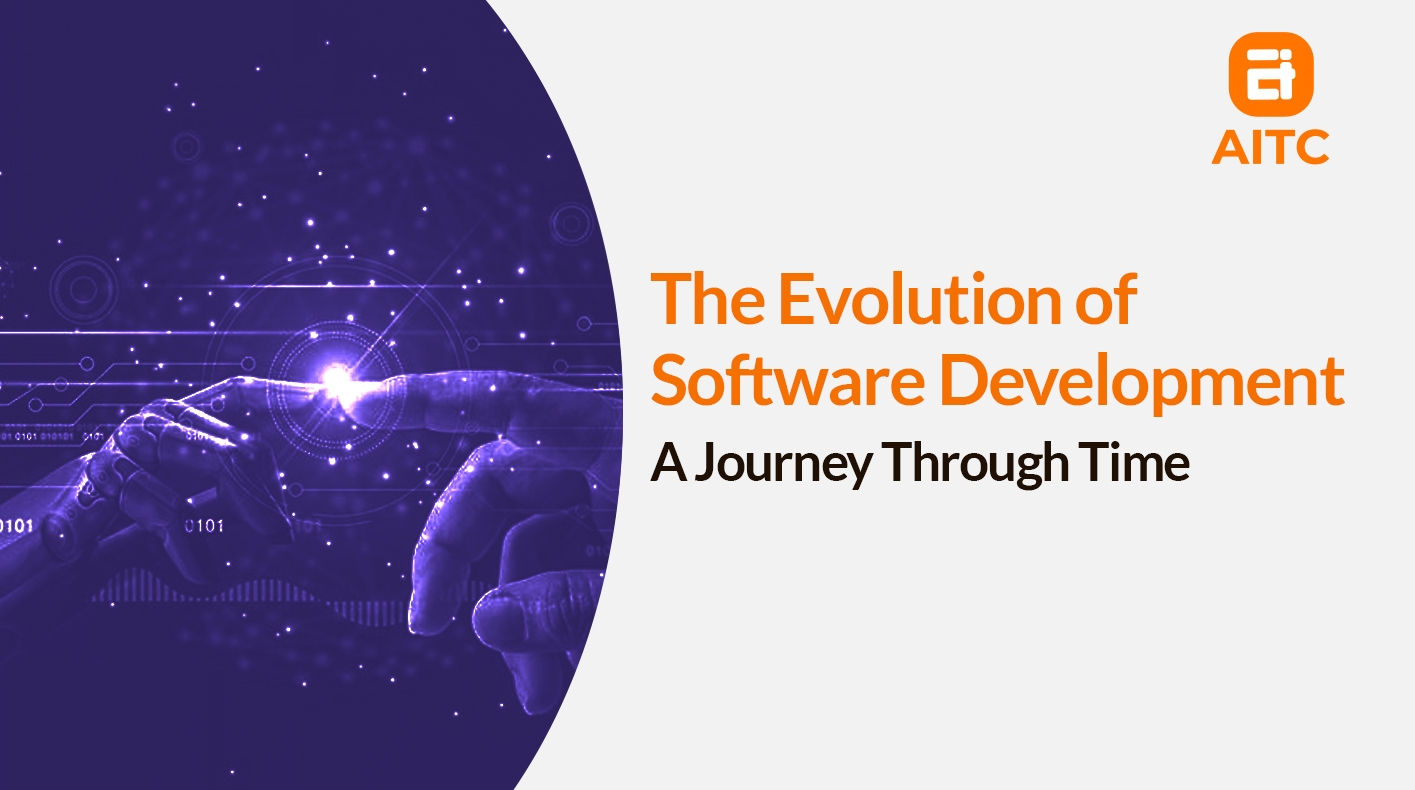
The Evolution of Software Development: a Journey Through Time

19 Dec 2025
Today, software is everywhere in our daily lives.
From mobile apps and websites to smart devices and automation systems, programming powers the modern digital world.
Software development was not always this advanced. Early programmers worked with machine code using only 1s and 0s.
Over time, programming languages, operating systems, cloud computing, and artificial intelligence transformed software.
In this blog, we explore the evolution of software development, key milestones, and future innovations shaping the tech industry.
Let's start!
History and timeline
Early Days: The Birth of Software Development (1940s–1950s):
This era marked the start of software development, where programs were built for specific computer hardware. Early mainframe computers were large machines that could only perform basic calculations. Programming was done using punch cards and machine code, which was hard to read and manage.
A major advancement came with Assembly language, which used human-readable instructions instead of binary code. This made programming more efficient and laid the foundation for modern programming languages.
- Software was hardware-specific and limited in functionality.
- Programming relied on punch cards and machine code.
- Assembly language became the first major milestone in software evolution.
The 1960s–1970s: Structured Programming & High-Level Languages
The 1960s saw the emergence of high-level languages like Fortran and COBOL, making programming more accessible and less error prone. This era also witnessed the rise of structured programming and the coining of the term "software engineering," marking a significant evolution in how software was developed and managed.
- Birth of high-level languages.
- Programming became more accessible and less prone to error.
- Marked the rise of structured programming and the term “software engineering”
The 1980s: The Personal Computer Revolution
The 1980s made computing more accessible to individuals and small businesses through the widespread adoption of personal computers (PCs). During this period, languages like C, which became standard for systems programming, were introduced. Graphical User Interfaces (GUIs) became more interactive and user-friendly, changing how users interacted with devices. Additionally, Integrated Development Environments (IDEs) and compilers became widely used, improving developers' ability to write and debug code efficiently.
- 1980s was the era which made computing more accessible to individuals and small businesses with the widespread of personal computers (PC’s)
- Languages like C, introduced during this period.
- Software became more interactive and user-friendly
- Integrated Development Environments (IDEs) and compilers became widespread.
The 1990s: The Internet and Object-Oriented Programming
As internet usage grew, the demand for web development increased. This period saw the rise of Object-Oriented Programming (OOP) with languages like Java and C++, introducing the concept of “objects” for easier management of complex systems and software reuse. Additionally, Agile software development emerged as a response to the rigidity of traditional waterfall methods, laying the foundation for modern development practices.
- Usage of the internet grew along with the need for web development.
- Rise of Object-oriented programming (OOP) with languages like java and C++.
- OOP introduced the concept of “objects”.
- Agile software development methodology took shape.
The 2000s: Open Source, Mobile, and Cloud Computing
This era marked a pioneering time for modern software development, with the open-source movement transforming how software was developed and shared. The global collaboration of developers led to improved software, while the rise of mobile app development, driven by smartphones and tablets, created new opportunities. Cloud computing revolutionized software delivery, with platforms like Amazon Web Services (AWS) offering infrastructure-as-a-service (IaaS), making software-as-a-service (SaaS) the new standard.
- Pioneering time for modern software development systems.
- Open-source movement flourished.
- Rise of mobile app development due to advent of smartphones and tablets.
- Cloud computing revolutionized the way of software delivery.
- Infrastructure-as-a-service (IaaS) and software-as-a-service (SaaS) became the new normal.
The 2010s: DevOps, AI, and Continuous Delivery
The 2010s introduced future-focused practices like DevOps, which combined software development (Dev) with IT operations (Ops), emphasizing automation, continuous integration, and continuous delivery (CI/CD). This shift enabled faster release cycles and more reliable software. Artificial intelligence (AI) and machine learning (ML) began assisting developers with tasks like bug detection and code completion. Meanwhile, Agile methodologies became the standard, evolving to focus on short development cycles and constant feedback from end-users.
- Adoptions of future centric practices like DevOps.
- Emphasized automation, continuous integration, and continuous delivery (CI/CD).
- Allowed faster release cycles and more reliable software.
- Artificial intelligence (AI) and Machine learning (ML) started making their way.
- Agile methodology established as the standard for software development.
The 2020s and Beyond: The Future of Software Development
Today, the landscape of software development continues to evolve at breakneck speed. We are seeing microservices and serverless computing reshape the way software is architected, allowing for more modular, scalable, and efficient applications. At the same time, low-code and no-code platforms are making it easier for non-developers to create applications.
As we look to the future, quantum computing promises to revolutionize software development by solving problems that were once thought insurmountable. Additionally, innovations in augmented reality (AR) and Virtual reality (VR) will provide new platforms for immersive software experiences.
Conclusion
From the humble beginnings of machine code to today’s cutting-edge AI-driven development tools, the evolution of software development has been nothing short of remarkable. With new technologies on the horizon, it’s clear that the next era of software development will be just as transformative as the previous ones. As developers, staying curious and adaptable is essential to keeping pace with the ever-changing landscape.

Related insights
-in-Business_1763716856557-585605410_2025-11-21.png&w=3840&q=75)
The Rise of Virtual and Augmented Reality (VR/AR) in Business
21 Nov 2025

Choosing the Right E-Commerce Platform for Your Nepal-Based Business
21 Nov 2025

What is SaaS? Understanding the Software as a Service Model for Modern Businesses
21 Jan 2026
Have a project in mind? Let's build something great.
Share your ideas or questions and our experts will get back to you shortly.
Unlock Expert Guidance
Need expert IT advice? Our seasoned professionals are here to help you navigate your tech challenges. Schedule a session with us and get personalized solutions tailored to your business needs.

Connect with Us and Let's Build Something Together
We'd love to hear from you! Whether you have questions, need support, or want to discuss a new project, our team is ready to assist. Fill out the form below, and we’ll get back to you as soon as possible.
Prefer a Direct Consultation?
Connect with our team for a 1-on-1 virtual session to discuss your project, understand your needs, and explore the right solution for your business.
What's Next?
- 1Connect with you at a convenient time
- 2Explore your needs, goals, and requirements
- 3Prepare a tailored proposal based on your needs
Why Choose Us
Connect with AITC
Select your inquiry type to route your request to the right department.
Our Office Locations
Operating across 3 key timezone hubs to serve global enterprise clients.