







SEO
SEO Best Practices 2026: Rank Higher with Proven Tips


sachin pokharel
26 Jan 2026
SEO best practices are strategic actions you apply to your website to improve visibility in search engine results. These include keyword research, on-page and off-page optimization, and creating user-focused content aligned with NLP techniques for better search engine understanding.
According to Backlinko, Google uses over 200 ranking factors to evaluate content. Following SEO best strategies increases your chances of ranking higher and attracting more organic traffic.
If you want to improve your website’s visibility, this guide will show up-to-date SEO strategies. Make sure you understand the basics of SEO to apply these strategies effectively.
Top SEO Best Practices to Boost Your Website Visibility
Top SEO best practices include optimizing on-page elements like titles, headings, and meta tags, improving page speed, and using mobile-friendly design. Create high-quality content and build authoritative backlinks to boost visibility. Optimize images with descriptive alt text, implement structured data, and enhance user experience to improve engagement and rankings.
1. Always Start with Keyword Research
Keyword research is the foundation of SEO because it helps you understand what your audience is searching for. By identifying high-traffic, low-competition keywords, you can create content that matches user intent, drives targeted traffic, and ranks higher in search results.
Before writing content, you need to understand your user intent and how they are searching for it.
For example:
- “Best laptops for college students” → informational, comparison intent.
- “Buy Dell XPS 13” → transactional, ready-to-purchase intent.
Align your content with searcher intent to satisfy queries effectively.
How to Find the Right Keywords:
- Use tools like Google Keyword Planner, Ahrefs, SEMRush, Ubersuggest, or AnswerThePublic.
- Check search volume, keyword difficulty, and related questions.
- Include long-tail keywords (e.g., “best running shoes for flat feet”) for lower competition and higher conversion potential.
- Explore Google’s “People Also Ask” and Related Searches for real search insights.
By focusing on intent-driven keywords, you ensure your content ranks higher and meets the needs of your audience.
Further Reading: Learn how to do keyword research step by step using free tools
2. Optimize Your On-Page Elements
Optimizing on-page elements like titles, headings, meta descriptions, and URLs helps search engines understand your content. This improves relevance for targeted keywords, boosts click-through rates and enhances user experience by making information easier to find.
Follow these On-Page SEO best practices:
- Title Tags: Keep titles under 60 characters and place the main keyword near the beginning. Example: 10 Easy Vegan Recipes for Beginners (2025 Edition).
- Meta Descriptions: Write clear, engaging descriptions to encourage clicks. Example: Discover 10 delicious vegan recipes that are easy to make and perfect for beginners.
- Headers: Use H1 for your main title, H2 for major sections, and H3 for sub-points. Include keywords naturally for better readability and SEO.
- URLs: Create clean, descriptive URLs. Example: yourwebsite.com/vegan-recipes-beginners. Avoid messy links like? id=829&ref=nav.
- Images: Add descriptive alt text, use relevant filenames (e.g., vegan-burrito.jpg), and compress images to reduce file size.
- Internal Linking: Link to relevant pages using keyword-rich anchor text to improve user experience, site authority flow, and crawl efficiency.
3. Create High-Quality, Helpful Content
Creating high-quality, helpful content boosts SEO because search engines prioritize content that satisfies user intent. It increases engagement, encourages backlinks, reduces bounce rates, and establishes your website as an authority, improving rankings and driving consistent, relevant traffic.
Follow these SEO content writing guidelines to create content that ranks well and engages readers:
- Write for People, Not Robots: Use conversational language, explain complex ideas clearly, and keep your content relatable.
- Focus on E-E-A-T: Build Experience, Expertise, Authoritativeness, and Trustworthiness by citing credible sources, including author bios, and updating content regularly.
- Cover Search Intent: Understand what users want and address their queries fully. Example: “How to start a podcast” → equipment, publishing steps, audience growth tips.
- Make Content Skimmable: Use bullet points, short paragraphs, visuals, pull quotes, and summary boxes to help readers find information quickly.
- Provide Clear Examples: Concrete examples make your content actionable and trustworthy.
Following these SEO tips and techniques improves search engine rankings, boosts engagement, encourages backlinks, and positions your website as an authority.
4. Build Authority with Backlinks
Backlinks from reputable websites signal trust and credibility to search engines. Follow these best practices to build authority effectively:
- Focus on High-Quality Links: Obtain backlinks from authoritative and relevant websites in your niche.
- Create Link-Worthy Content: Publish useful, original content that others naturally want to reference.
- Use Diverse Sources: Acquire links from blogs, news sites, directories, and industry publications.
- Anchor Text Matters: Use descriptive, keyword-relevant anchor text naturally, without over-optimization.
- Monitor Backlinks: Regularly check your backlink profile to remove spammy or low-quality links.
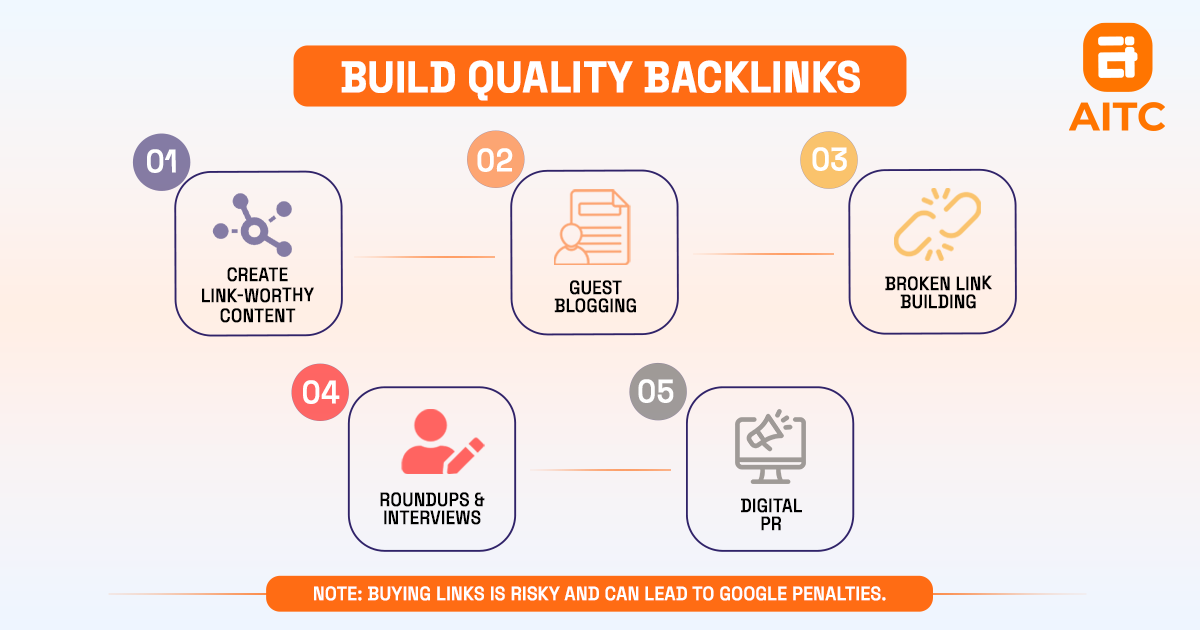
How to Create Backlinks?
Building backlinks from reputable websites improves SEO, authority, and referral traffic. Follow these proven SEO tactics:
- Create Link-Worthy Content: Publish helpful, unique, or surprising content, such as original research, industry statistics, or long-form guides that naturally attract links.
- Guest Blogging: Write valuable articles for other blogs in your niche and include relevant links back to your site. Ensure content is high-quality and contextually relevant.
- Broken Link Building: Find broken links on relevant websites and suggest your content as a replacement, creating a win-win for both sites.
- Roundups and Expert Interviews: Reach out to blogs or publications that feature expert roundups. Being featured earns backlinks and increases exposure.
- Digital PR: Use platforms like HARO (Help A Reporter Out) to provide expert insights to journalists and earn authoritative backlinks.
- Avoid Buying Links: Never purchase backlinks. Google penalizes unnatural link patterns. Focus on building genuine connections and quality content to earn links naturally.
Benefits of High-Quality Backlinks:
- Boosts website credibility and domain authority.
- Improves search engine rankings.
- Drives referral traffic from trusted sources.
Further Reading: Understand the fundamentals of Off-page SEO
5. Measure, Analyze, and Improve your Website
Monitoring your website helps identify what works, fix issues, and boost SEO and user experience. Track metrics like traffic, bounce rate, and conversions to make data-driven improvements.
Steps to improve your website:
- Use Google Search Console (GSC) and Analytics
- Track keywords, clicks, impressions, and indexing errors.
- Monitor bounce rate, time on page, and traffic sources.
- Fix crawl errors and submit updated sitemaps.
- Monitor Key Metrics
- CTR (Click-Through Rate): Low CTR may indicate titles or meta descriptions need improvement.
- Dwell Time: Longer visits signal higher engagement.
- Pages per Session: More pages viewed indicate deeper interest and higher authority.
- Update Old Content
- Add updated statistics and examples.
- Improve clarity and readability.
- Add new internal links and optimize images.
- Refresh titles with trending phrases like “best,” “top tips,” or “2025 trends.”
- Make Data-Driven Decisions
- Optimize content and fix issues based on insights.
- Continuously monitor performance to maintain and improve SEO results.
6. Technical SEO Essentials
Technical SEO ensures search engines can crawl, index, and understand your website. Optimizing site speed, mobile-friendliness, HTTPS, structured data, and URLs improves rankings, user experience, and overall site performance.
Steps to improve technical SEO:
- Make Your Site Mobile-Friendly
- Use responsive design for all devices.
- Avoid tiny fonts and ensure readability.
- Make buttons large and clickable.
- Avoid pop-ups that cover content.
- Improve Site Speed
- Compress images to reduce file size.
- Enable lazy loading for faster page display.
- Minify CSS and JavaScript.
- Use a Content Delivery Network (CDN).
- Test speed with PageSpeed Insights.
- Secure Your Site with HTTPS
- Enable SSL to protect user data.
- Redirect all traffic to the secure version.
- Builds trust and improves SEO rankings.
- Use XML Sitemaps and Robots.txt Wisely
- Sitemap: Lists all important pages for easier crawling.
- robots.txt: Specifies which pages not to crawl.
- Submit your sitemap to Google Search Console for faster indexing.
- Add Structured Data (Schema Markup)
- Helps Google understand content better.
- Examples: Recipe schema for blogs, Review schema for products, FAQ schema for support pages.
- Test pages with Google’s Rich Results Test.
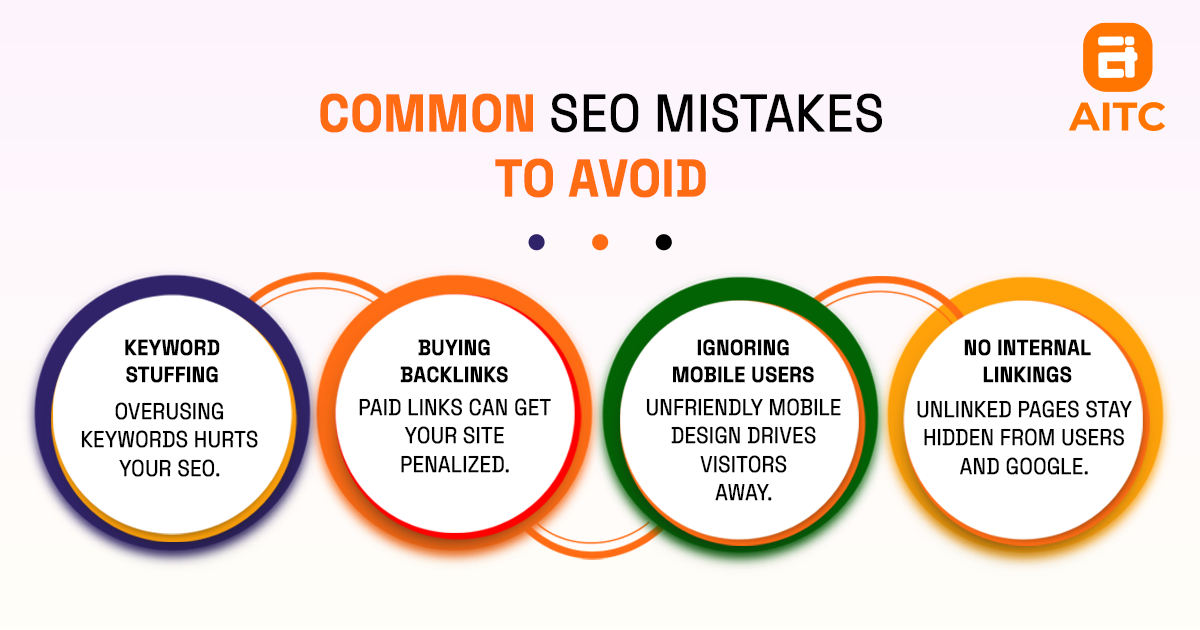
What are Common SEO Mistakes to Avoid?
Avoid keyword stuffing, ignoring mobile optimization, duplicate content, missing alt text, slow site speed, broken links, poor backlinks, skipped analytics, weak on-page SEO, and technical errors to improve rankings, traffic, and user experience.
1. Keyword Stuffing
What it is: Forcing a target keyword into every sentence or paragraph to try to rank higher.
Why it’s bad:
- Hurts readability: Makes content confusing or hard to follow.
- Reduces usefulness: Fails to answer user questions effectively.
- Search engine penalties: Google detects over-optimization and can lower your rankings.
- Decreases engagement: Readers may leave your page quickly, increasing bounce rate.
How to avoid it:
- Write naturally and focus on user intent.
- Include keywords only where they fit contextually.
- Answer the reader’s questions thoroughly and clearly.
Tip: High-quality, helpful content signals relevance to search engines without overusing keywords.
2. Buying Backlinks
What it is: Purchasing links from other websites to try to boost your rankings.
Why it’s bad:
- Violates Google’s guidelines: Can trigger penalties and lower rankings.
- Low-quality links: Cheap backlinks often come from spammy or irrelevant sites.
- Wasted effort: Paid links rarely provide meaningful traffic or authority.
How to avoid it:
- Create high-quality content that people naturally want to share.
- Build relationships with bloggers or industry experts.
- Contribute guest posts, participate in expert roundups, or provide quotes.
Tip: Focus on earning quality backlinks rather than buying them; they are more valuable for SEO and site authority.
3. Ignoring Mobile Users
What it is: Failing to optimize your website for mobile devices.
Why it’s bad:
- Poor user experience: Tiny text, small buttons, and content that doesn’t fit the screen frustrates users.
- Higher bounce rates: Visitors leave quickly, signaling low engagement.
- Negative SEO impact: Google uses mobile-first indexing, so poor mobile performance can lower rankings.
How to avoid it:
- Make your website responsive across all devices.
- Test on multiple screen sizes.
- Use tools like Google’s Mobile-Friendly Test.
Tip: A mobile-optimized site improves engagement, rankings, and overall user experience.
4. Neglecting Site Speed
What it is: Failing to optimize your website for fast loading.
Why it’s bad:
- Poor user experience: Slow pages frustrate visitors.
- Higher bounce rates: Users leave if a page takes too long to load.
- Negative SEO impact: Page speed is a confirmed Google ranking factor.
How to avoid it:
- Compress images to reduce file size.
- Use caching plugins to speed up repeat visits.
- Minify unnecessary CSS and JavaScript.
- Test your site with PageSpeed Insights and follow its recommendations.
Tip: A fast-loading website improves engagement, rankings, and overall user experience.
5. Letting Content Go Outdated
What it is: Failing to update older content with fresh information, accurate stats, or relevant examples.
Why it’s bad:
- Lower search rankings: Google favors fresh and accurate content.
- Broken links or outdated info: Reduces user trust and engagement.
- Missed traffic opportunities: Old content may no longer match user intent.
How to avoid it:
- Regularly review top-performing content every few months.
- Update statistics, examples, and case studies.
- Add new sections or insights to keep content relevant.
Tip: Even minor updates can improve rankings, engagement, and user trust.
6. No Internal Linking
What it is: Failing to connect your website pages and blog posts with internal links.
Why it’s bad:
- Reduces crawlability: Google may struggle to discover all your pages.
- Poor user experience: Visitors miss related content and leave sooner.
- Lost SEO value: Link equity isn’t distributed across your site, limiting ranking potential.
How to avoid it:
- Link naturally between related posts and pages.
- Mention older articles when relevant.
- Use descriptive anchor text to indicate the linked page’s topic.
Tip: Internal linking improves SEO, keeps users engaged longer, and helps Google understand site structure.
Key Takeaways: SEO Best Practices
- SEO best practices help search engines crawl, understand, and rank your website while improving overall user experience.
- Clean, keyword-optimized titles, meta descriptions, URLs, and headings improve relevance and click-through rates.
- Helpful, trustworthy, and well-structured content consistently outperforms keyword-stuffed or thin pages.
- Strong technical SEO—including site speed, mobile optimization, HTTPS, and structured data—is essential for stable rankings.
- High-quality backlinks act as trust signals and carry more value than large volumes of low-quality links.
- Ongoing monitoring with Google Search Console and Google Analytics enables data-driven SEO improvements.
- Avoiding common SEO mistakes—such as keyword stuffing, slow pages, poor mobile experience, and outdated content—prevents ranking drops.
- Businesses that follow these practices or work with AITC International’s SEO services gain sustainable visibility, qualified traffic, and long-term growth.

Related insights

Internal Linking: Best Practices & SEO Pitfalls to Avoid
26 Jan 2026

What Are Heading Tags and Why They Matter for SEO in 2025?
13 Oct 2025

How to Write SEO-optimized Content?
13 Oct 2025
Have a project in mind? Let's build something great.
Share your ideas or questions and our experts will get back to you shortly.
Unlock Expert Guidance
Need expert IT advice? Our seasoned professionals are here to help you navigate your tech challenges. Schedule a session with us and get personalized solutions tailored to your business needs.

Connect with Us and Let's Build Something Together
We'd love to hear from you! Whether you have questions, need support, or want to discuss a new project, our team is ready to assist. Fill out the form below, and we’ll get back to you as soon as possible.
Prefer a Direct Consultation?
Connect with our team for a 1-on-1 virtual session to discuss your project, understand your needs, and explore the right solution for your business.
What's Next?
- 1Connect with you at a convenient time
- 2Explore your needs, goals, and requirements
- 3Prepare a tailored proposal based on your needs
Why Choose Us
Connect with AITC
Select your inquiry type to route your request to the right department.
Our Office Locations
Operating across 3 key timezone hubs to serve global enterprise clients.