







SEO
How to Write Seo-optimized Content?


sachin pokharel
13 Oct 2025
You’ve probably heard this phrase: “Just write high-quality content and the rankings will follow.”
But what is high-quality content, and how to write it?
In this blog, you’ll gain a clear understanding of the concept, and you’ll be able to apply it to your writing right away.
1. Understand and Research Your Audience
Learning about your audience means finding out who they are, what they’re looking for, and the challenges they face. This helps you craft content that truly connects, choose suitable keywords, and boost engagement, trust, and SEO results effectively.
You can research your audience by:
--> Conducting Surveys & Interviews
Ask your existing customers or target audience about their challenges and needs. Tools like Google Forms or SurveyMonkey can help.
--> Using Social Media Listening Tools
Identify what your audience is talking about on social media platforms likeX ( Twitter), Facebook groups, Reddit, and LinkedIn. Monitor which questions they’re asking, and which topics are trending in your niche. This helps uncover pain points and emerging interests.
--> Analyzing Website Analytics (Google Analytics)
Dive into data about your current website visitors. Which pages do they visit most? How long do they stay? What are their demographics? Where do they come from?
--> Talking to Customer Support and Sales Teams
Your support and sales teams interact directly with customers daily.
They hear common complaints, questions, and feedback. Collaborating with them gives you real-world insights into what your audience really needs and expects.
--> Exploring Forums and Q&A Sites (Reddit, Quora)
Platforms like Quora and Reddit are goldmines for discovering what your audience is curious about. Look for frequently asked questions, recurring pain points, and themes relevant to your niche. These platforms provide real, unfiltered audience insights.
The next step is understanding search intent. Understanding search intent is crucial for writing quality content that users are looking for.
There are four primary types you should know:
- Informational Intent (Know)
The user is looking to learn something. Example: “How to train a puppy” - Navigational Intent (Go)
The user wants to find a specific website or brand. Example: “Facebook login” - Commercial Investigation Intent (Do-Know)
The user is comparing options before making a purchase. Example: “best laptops for students” - Transactional Intent (Do)
The user is ready to take action—make a purchase, sign up, or download. Example: “buy iPhone 14 online”
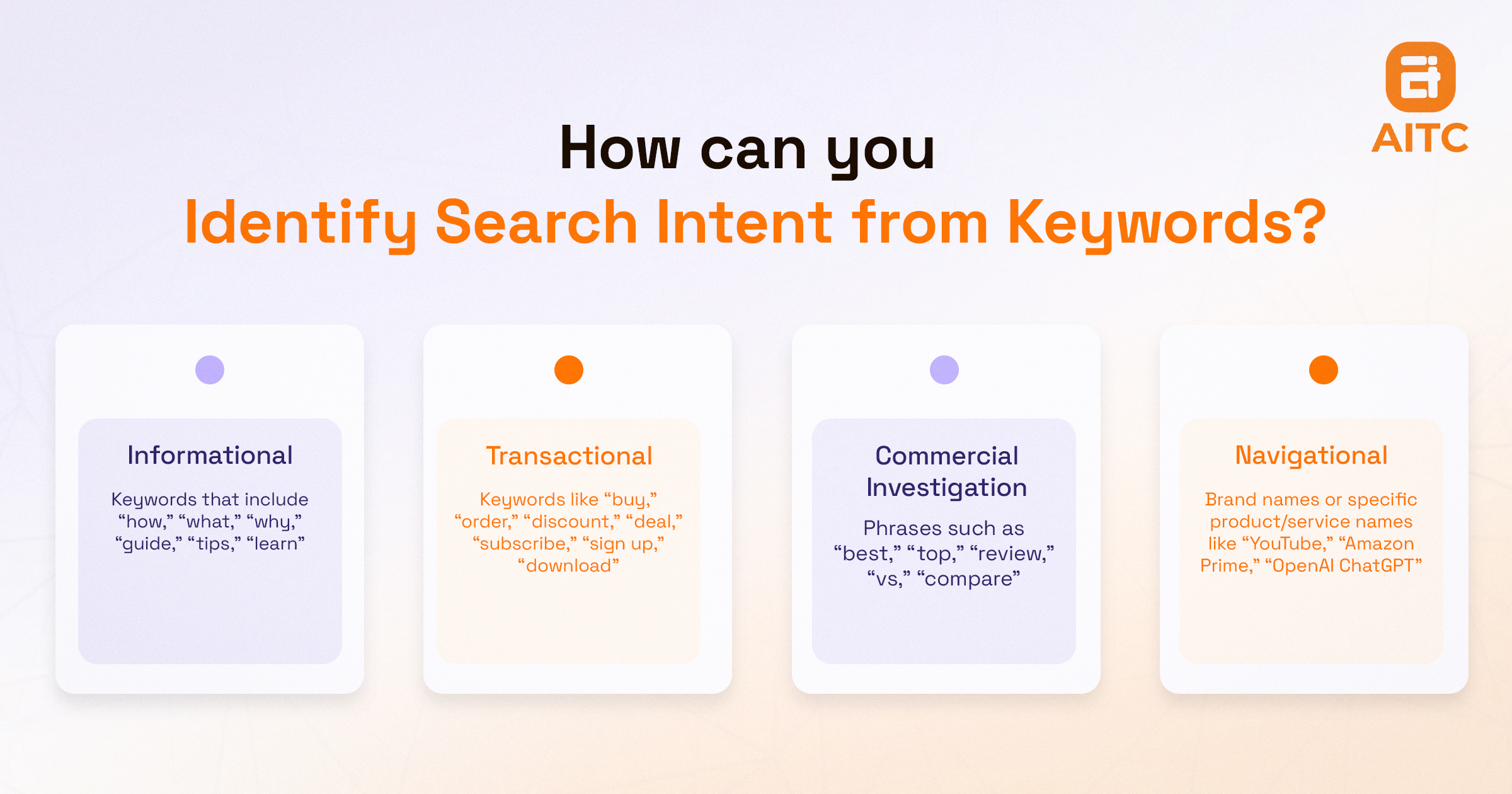
How can you Identify Search Intent from Keywords?
Certain words signal specific types of intent.
Here’s how to decode them:
- Informational: Keywords that include “how,” “what,” “why,” “guide,” “tips,” “learn”
- Transactional: Keywords like “buy,” “order,” “discount,” “deal,” “subscribe,” “sign up,” “download”
- Commercial Investigation: Phrases such as “best,” “top,” “review,” “vs,” “compare”
- Navigational: Brand names or specific product/service names like “YouTube,” “Amazon Prime,” “OpenAI ChatGPT”
2. Conduct Keyword Research
Keyword research helps you discover what your audience is actively searching for. It guides your content strategy, aligns your topics with user intent, and improves your chances of ranking higher in search engine results—driving targeted, organic traffic.
You can conduct keyword research by:
- Start by identifying topics relevant to your audience.
- Use Keyword research tools to find related keywords.
- Check their search volume, competition, and intent.
- Focus on terms that match your content goals.
For more detailed information on how to do keyword research, you can visit our blog.
Some of the Free keyword research tools are:
- Google Keyword Planner
- Google Search (Autosuggest & Related Searches)
- People Also Ask (PAA) Box
- AnswerThePublic
- Google Trends
- Reddit & Forums
Some of the best Paid keyword research tools are:
- Ahrefs
- SEMrush
- Ubersuggest
- Moz Keyword Explorer
3. Plan & Structure your Content
Planning and structuring your content ensures clarity, consistency, and purpose. It helps you stay focused on your audience’s needs, organize information logically, and improve readability.
A clear structure also guides search engines, boosting SEO performance and making your content easier to index and rank.
How to plan and structure your content?
Organize your idea by creating a clear outline using headings and subheadings. Begin with a compelling introduction, followed by well-structured sections that are easy to scan. Use visuals, bullet points, and internal links to enhance readability and SEO.
Let's understand in detail:
- Use Headings (H1, H2, H3, etc.)
Headings organize your content better, making it easier for search engines and users to understand. They improve content readability, break text into clear sections, and help readers find information quickly.
How to use headings in content?
There are six levels of HTML headings, designed to organize content.
- Use One H1 Tag Per Page
- Use H2 Tags for Main Sections
- Use H3 to H6 for Subsections
4. Write Engaging & Optimized Content
Write content that grabs attention with a strong hook, solves a user’s problem, and outlines clear benefits. Use short paragraphs, keyword-rich headings, visuals, and lists for clarity. End with a recap, CTA, and next steps to keep readers engaged.
Let's understand it.
Grab user attention immediately
Grabbing user attention immediately boosts SEO by reducing bounce rates and increasing dwell time. A compelling hook keeps users engaged, showing Google your content is relevant and valuable.
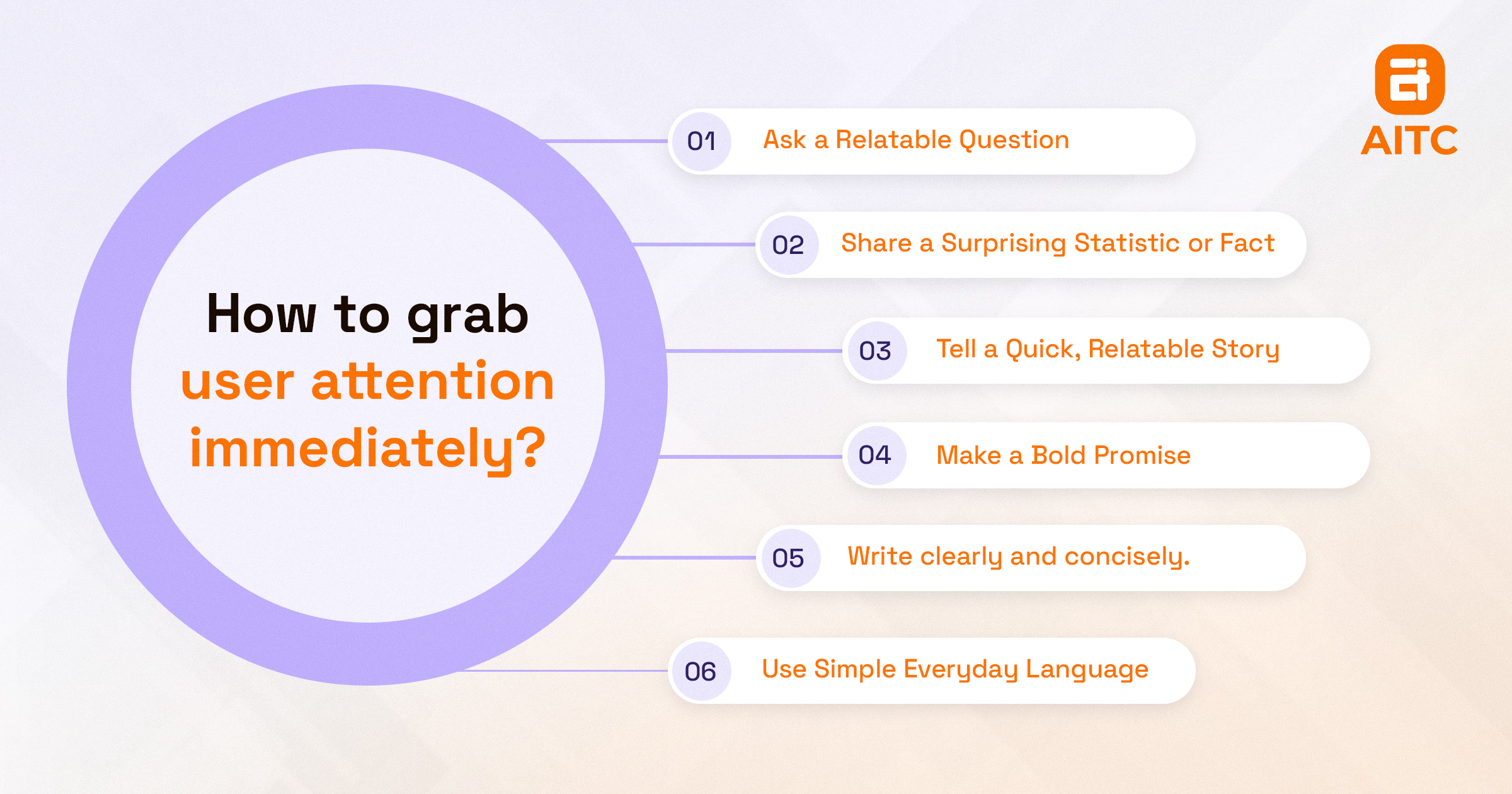
How to grab attention?
Here are Proven Ways to Grab User Attention Immediately:
Ask a Relatable Question
Asking the user a question that directly resonates with their pain point, curiosity, or aspiration engages the readers.
Example: "Struggling to get your blog posts noticed by Google? You're not alone."
Share a Surprising Statistic or Fact
Sharing a surprising statistic or fact in the introduction captures attention quickly and builds credibility. For SEO, it increases engagement and encourages users to keep reading—boosting dwell time and signaling to search engines that your content is authoritative and relevant.
Example: "Did you know that over 90% of online content published today receives zero organic traffic? Don't let your valuable insights disappear into the digital abyss."
Tell a Quick, Relatable Story
Humanize your content and make it relatable by starting with a brief, relevant narrative that illustrates the problem or solution.
Example: "Just last month, Sarah was tearing her hair out trying to figure out why her beautifully written articles, packed with research, simply weren't showing up in search results..."
Make a Bold Promise
Stating a bold claim or promise grabs attention instantly and sets a strong expectation for value. It boosts engagement by encouraging users to read further, increasing time on page—an important ranking factor that signals content relevance to search engines.
Example: "By the end of this comprehensive guide, you'll possess the secret strategies and practical steps to make your content not just visible, but truly soar in search rankings, attracting your ideal audience."
Write clearly and concisely.
When your writing is straightforward, users stay longer, find what they need faster, and are more likely to take action.
Plus, search engines can better understand and rank your content when it’s well-structured and aligned with user intent.
Here’s how to write content that’s clear, concise, and search-optimized.
Use Simple Everyday Language
Avoid technical jargon, buzzwords, or complex phrases—unless your audience expects them.
Simple language improves comprehension, keeps readers engaged, and helps search engines easily understand your content.
Example: Instead of saying "optimize the UX of your digital asset", say "improve how users experience your website."
Write Short, Digestible Sentences
a. Short sentence
Using short sentences improves comprehension by making information easier to process. They also highlight key ideas, helping important messages stand out to readers.
So,
- Try to keep most sentences between 12 and 20 words.
- Break up ideas into shorter, punchier thoughts.
- Use bullet points to organize information.
Short sentences improve readability scores and encourage more people to keep reading.
b. Answer Directly Under Each Heading
Answering directly under the heading helps the user find the answer instantly. This also aligns with semantic SEO best practices and signals relevance to search engines.
Try to answer the user's question in a Q&A format—quick and straight to the point.
Humanize Your Content with Empathy and Storytelling
a. Use Real Examples and Case Studies
Real examples and case studies make your content more credible and easier to understand.
By grounding your ideas in real-life scenarios, you give your audience something they can relate to—and believe in. This boosts user trust, engagement, and SEO relevance.
For Example, instead of saying, “Clear writing improves SEO,” say:
"After simplifying their blog content, one client saw a 47% increase in organic traffic within 30 days."
b. Speak Directly to Your Reader
Use personal language such as "you" and "your" to build a stronger connection and make your content feel like a one-on-one conversation.
Speaking directly builds connection and makes the reader feel seen, heard, and understood.
For example: "You don’t need to be a professional writer to create high-performing content—you just need the right approach."
c. Show You Understand Their Struggles
Showing empathy creates trust. When readers feel heard and understood, they’re more likely to engage, share, and take action. They stop seeing you as “just another content creator” and start seeing you as a guide who gets them.
What to do:
- Acknowledge common frustrations or challenges.
- Use phrases that reflect shared experiences.
- Avoid overpromising or sounding superior.
Examples of empathetic language:
- “We’ve all felt stuck staring at a blinking cursor…”
- “It’s frustrating when you pour hours into writing and still don’t see results.”
- “If you’ve been there, you’re not alone—and there’s a better way.”
Content that emotionally resonates is more likely to be bookmarked, linked to, and shared—powerful signals that increase your domain authority.
Optimize On-Page elements for search engines
Optimizing on-page elements like titles, meta descriptions, headers, and URLs helps search engines better understand your content. It boosts relevance, improves rankings, and ensures users quickly find what they’re looking for.
a. Write engaging Title Tags & Meta Descriptions
Writing an engaging title and meta description is essential for improving both click-through rates (CTR) and search engine optimization (SEO).
b. How to write engaging title tags?
- Make the title 50-60 characters long to avoid truncation.
- Try to include your primary keyword at the beginning of the title.
- Make the title compelling enough to click.
- Avoid generic or duplicate titles.
c. How to write an engaging meta description?
- Keep it between 150–160 characters to ensure your full message is visible across most devices and search results.
- Write it like a mini-advertisement for your page — focus on user benefits and clearly explain what problem you solve or value you offer.
- Naturally integrate your primary keyword and relevant secondary keywords to boost visibility in search results. Google may bold-match keywords, increasing clickability.
- Use conversational, natural-sounding phrases that align with how real people search. Avoid keyword stuffing — prioritize clarity and intent match.
d. Make URLs Clean and include keywords naturally
Clean URLs with keywords integrated naturally help search engines and users understand page content easily. They improve crawlability, boost rankings, and enhance user trust, making links more clickable and shareable.
- Avoid long, complex, or messy URLs with unnecessary parameters.
- Include your primary keyword (or a close variation) in the URL.
- Always separate words with hyphens in URLs—avoid using underscores or blank spaces.
- Avoid stop words like "a," "the," "and," "of".
e. Place keywords naturally through your content.
Naturally placing keywords helps search engines understand your content without hurting readability. It enhances SEO by making content flow conversational, boosting user engagement, and reducing bounce rates.
Where to place your keyword in content?
- Include your primary keyword naturally in the first paragraph, ideally within the first 100-150 words.
- Use your primary, secondary, and LSI keywords strategically in your headings and subheadings.
- Sprinkle your primary, secondary, and LSI keywords throughout the content naturally.
- Use a primary or secondary keyword in the meta description.
5. Link your related page
Internal linking helps search engines crawl your site and helps users explore related content easily. This improves crawlability, indexing, and boosts engagement metrics, and reduces bounce rates.
- Link from within the main body of your content where it naturally adds value or provides relevant information.
- Use descriptive anchor text that accurately reflects the content of the linked page.
- Prioritize High-Value Pages
- Avoid overstuffing pages with too many links.
6. External link
Linking to reputable, relevant sources boosts your content’s credibility and signals to search engines that it’s well-researched.
- Only link to trusted, high-authority websites in your industry. Avoid low-quality or irrelevant domains.
- Open Links in New Tabs (target="_blank") to keep users on your site while visiting extra resources.
- Make sure your external links are contextually aligned and add value to the topic being discussed.
Key Takeaways
- Understand your audience’s needs, pain points, and behavior to create content that resonates and ranks.
- Organize content using clear headings, subheadings, and bullet points to enhance readability and crawlability.
- Answer user questions directly under each relevant heading to meet semantic SEO best practices.
- Optimize on-page elements like title tags, meta descriptions, headers, and URLs using target keywords naturally.
- Include internal links to related content for improved site structure and user navigation.
- Focus on providing helpful, comprehensive, and user-focused content that search engines love.

Related insights

SEO Best Practices 2026: Rank Higher with Proven Tips
26 Jan 2026

Internal Linking: Best Practices & SEO Pitfalls to Avoid
26 Jan 2026

What Are Heading Tags and Why They Matter for SEO in 2025?
13 Oct 2025
Have a project in mind? Let's build something great.
Share your ideas or questions and our experts will get back to you shortly.
Unlock Expert Guidance
Need expert IT advice? Our seasoned professionals are here to help you navigate your tech challenges. Schedule a session with us and get personalized solutions tailored to your business needs.

Connect with Us and Let's Build Something Together
We'd love to hear from you! Whether you have questions, need support, or want to discuss a new project, our team is ready to assist. Fill out the form below, and we’ll get back to you as soon as possible.
Prefer a Direct Consultation?
Connect with our team for a 1-on-1 virtual session to discuss your project, understand your needs, and explore the right solution for your business.
What's Next?
- 1Connect with you at a convenient time
- 2Explore your needs, goals, and requirements
- 3Prepare a tailored proposal based on your needs
Why Choose Us
Connect with AITC
Select your inquiry type to route your request to the right department.
Our Office Locations
Operating across 3 key timezone hubs to serve global enterprise clients.