







Business
Web development
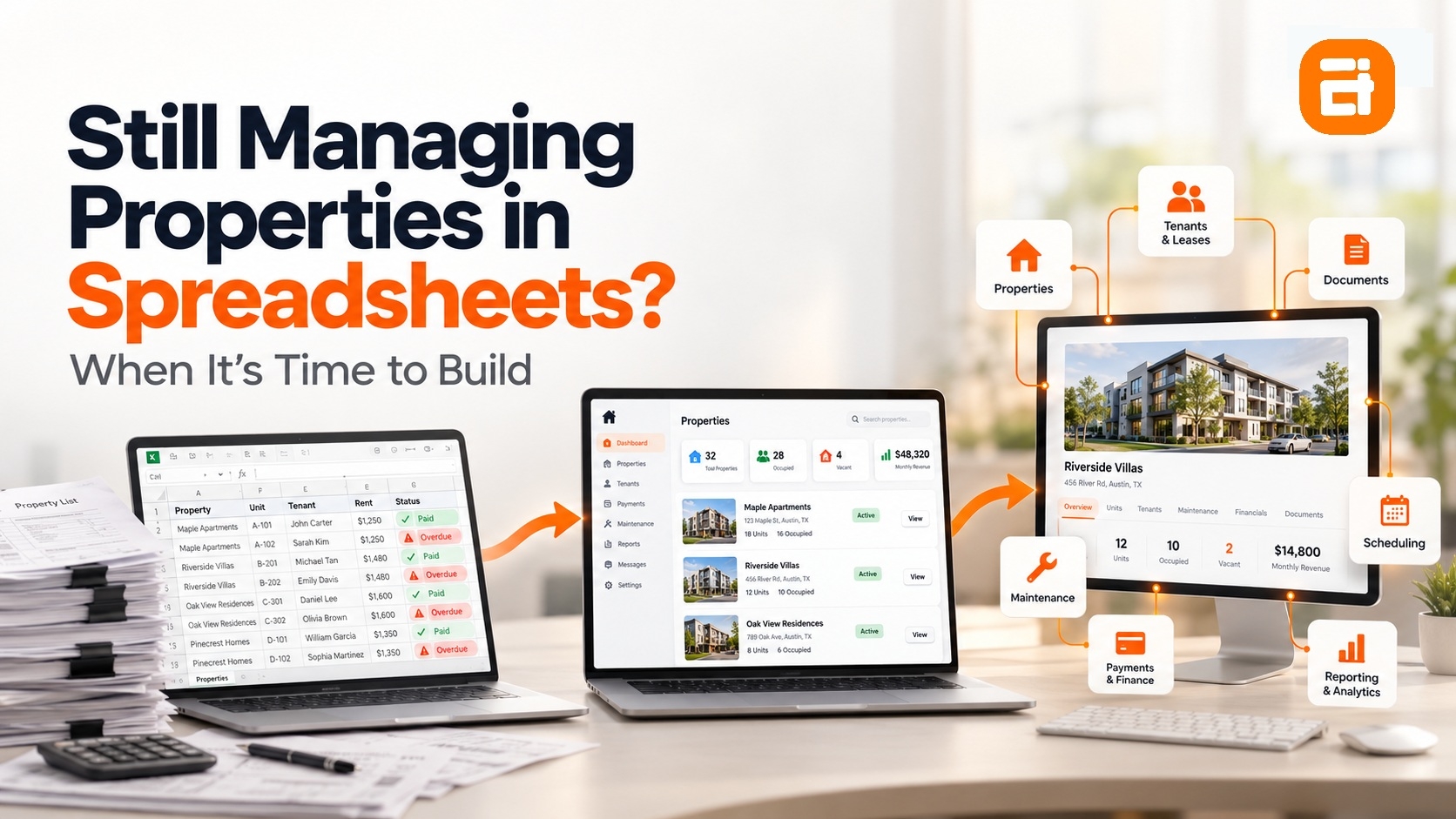
Still Managing Properties in Spreadsheets? When to Build Instead

sachin pokharel
26 Oct 2026
Property businesses need to move beyond spreadsheets when rent, maintenance, deadlines, and reporting depend on repeated manual checks instead of one reliable system.
However, most teams benefit from adopting established property management software before considering custom development.
A custom build becomes relevant when client money, fee structures, landlord statements, or evidence requirements cannot fit a standard platform.
This blog explains when spreadsheets stop working, when off-the-shelf software is sufficient, and when custom property management software becomes the right investment.
Key Highlights
- Most property businesses should adopt established property software before considering a custom build.
- Spreadsheets become risky when payments, obligations, maintenance, and reporting rely on memory or manual reconciliation.
- Custom software becomes relevant when client money, fee structures, landlord statements, or evidence requirements exceed a platform's operating model.
- Portfolio size alone does not determine the right system because operational complexity matters more than property count.
- A one-week workflow audit can show whether you should configure, integrate, extend, or replace your current tools.
Spreadsheets, Software, or Custom Build: Where You Are Now
Your correct stage depends on operational complexity, especially whose properties, money, reporting, and obligations your team manages.
Portfolio size matters, but a small agency with different landlord agreements may face more complexity than a larger owner-operated portfolio with consistent processes.
| What describes your operation | Likely answer | Why |
| Small portfolio with simple, stable processes | Keep the spreadsheet for now | Limited complexity keeps manual control manageable |
| One consistent ownership and management model | Buy off-the-shelf software | Mature platforms already support standard workflows |
| Client funds require clear allocation and reconciliation | Consider extending or building | Financial relationships need stronger traceability |
| Standard dates, documents, and reminders | Buy off-the-shelf software | Existing platforms handle routine obligation tracking |
| Bespoke statements or fee rules vary by landlord | Consider extending or building | Recurring exceptions create manual reconstruction |
Stage 1: When Spreadsheets Stop Working
Spreadsheets stop working when routine property decisions depend on manual checking, personal memory, or files that no longer provide one reliable record.
The failure develops gradually as workarounds create delayed arrears, missed obligations, fragmented maintenance histories, and slower reporting.
1. Nobody Is Sure Which File Is Current
Your property records are unreliable when staff cannot immediately identify which spreadsheet contains the latest information.
Copies spread across desktops, shared drives, and email attachments, allowing different employees to update conflicting versions.
Once staff must validate the file before using its data, the spreadsheet is no longer a dependable system of record.
2. Dates Are Only Remembered If Someone Remembers Them
Dates become operational risks when the spreadsheet records a deadline but cannot assign, escalate, or prove the action that follows it.
Property teams track renewals, inspections, certificate expiry, notices, and maintenance schedules.
Effective obligation management connects each deadline to an owner, reminder, evidence, status, and completion history.
3. Arrears Are Found After the Fact
Arrears are discovered too late when expected rent and received payments are compared only through periodic manual reconciliation.
A missed or partial payment can remain unnoticed until someone checks bank activity against the rent roll.
A reliable process links the expected amount, payment received, balance, property, and follow-up status as the exception occurs.
4. Maintenance Lives in Messages, Not the System
Maintenance becomes unmanageable when calls, emails, and messages contain the history instead of one structured property record.
A dependable record should show what was reported, when it was assigned, who handled it, and how it was resolved.
That history becomes essential when work is delayed, repeated, disputed, or charged back.
If the same fragmentation affects other operations, review the broader signs that a business has outgrown spreadsheets .
Stage 2: When Off-the-Shelf Property Software Is the Right Answer
Off-the-shelf property software is the right answer when your workflows are standard enough to fit a mature platform with limited configuration.
Established products already solve common tenancy, maintenance, payment, reminder, and reporting problems faster than a custom project can.
What Established Platforms Genuinely Do Well
Established platforms handle standard property records, reminders, maintenance, payments, and reporting more efficiently than a new custom build.
- Tenancy records: Properties, units, landlords, tenants, agreements, and occupancy information remain in one structured system.
- Scheduled reminders: Renewals, inspections, certificates, payment dates, and recurring tasks no longer depend on personal calendars.
- Maintenance ticketing: Requests become work orders with owners, statuses, notes, contractors, and completion history.
- Payments and reporting: Staff can track rent, arrears, statements, and portfolio reports without rebuilding them manually.
Building these standard capabilities from scratch is usually an expensive route to functions the market already provides.
How to Tell Whether a Standard Platform Will Fit
A standard platform will fit when your management model, fee structures, and landlord reporting remain consistent across most of the portfolio.
- Properties follow one management model: The same core process works across most landlords, units, and tenancies.
- Fees follow stable rules: Staff are not calculating different structures or exceptions for every client.
- Landlords accept standard statements: Reports can be configured without rebuilding outputs manually each month.
If these conditions are true, configure or buy an established product instead of commissioning custom property management software.
Stage 3: When Property Software Does Not Fit Either
Custom property software becomes worth evaluating when recurring financial, reporting, or evidence rules cannot be represented reliably inside an established platform.
The mismatch must be structural, forcing staff to maintain parallel spreadsheets, rebuild outputs, or reconcile the platform against another source every operating cycle.
You Manage Other People's Money
Managing other people's money requires every receipt, deduction, adjustment, and balance to remain attributable to the correct parties and property.
- Collected rent has an owner: Each payment may relate to a landlord, property, tenancy, period, and outstanding balance.
- Deductions change what is owed: Management fees, contractor payments, adjustments, and other charges affect the amount payable.
- History must remain traceable: Staff should reconstruct why a balance changed without relying on a separate spreadsheet.
Confirm applicable local financial-handling obligations before designing the workflow because requirements vary by jurisdiction.
Every Landlord Wants a Different Statement
Statement generation becomes a custom-software problem when landlord-specific fees, periods, deductions, or formats require staff to rebuild reports every month.
- Fee structures differ: Percentage fees, fixed charges, service costs, and exceptions change the calculation logic.
- Reporting periods differ: Clients may require monthly, property-level, or portfolio-level reporting.
- Output formats differ: Teams may export the same data repeatedly and reconstruct it into separate statement layouts.
AITC Homes, AITC's apartment and visitor-management platform, keeps apartment billing history and management reporting inside one property system rather than across disconnected files.
Statements should come from structured operational data, not from staff manually recreating the same financial history each month.
When reporting, accounting, maintenance, documents, and communication remain separate, disconnected business tools make every handoff slower and harder to verify.
Obligations Have to Be Provable, Not Just Tracked
Property obligations must produce a retrievable completion record because a reminder alone cannot prove that the required action occurred.
- Documents need context: Certificates, agreements, notices, inspection records, and consents should remain linked to the correct property or tenancy.
- Actions need history: The record should show when an obligation was identified, assigned, completed, and supported with evidence.
- Evidence needs retrieval: Staff should produce the relevant history without searching across inboxes, folders, and personal messages.
A reminder shows that something is due; a dependable operational record shows what happened next.
What Custom Property Software Really Costs
Custom property software costs should be compared against the full operating cost of your current tools, workarounds, integrations, and manual labor.
Add subscriptions, add-ons, integrations, and staff time spent rebuilding statements, checking arrears, tracing maintenance, finding documents, and reconciling records.
AITC’s discovery conversations have shown that monthly statement preparation can cost property businesses more than expected once the associated staff hours are calculated.
Compare that total with development, migration, hosting, support, maintenance, and future changes.
A lower-risk first scope may add a statement, fee, reporting, or integration layer while the current system handles standard tenancy workflows.
The guide to software development cost explains the factors shaping development effort and long-term ownership.
Count the Hours Before You Count the Licenses
A 30-minute consultation can map the statements, arrears, obligations, integrations, and workarounds shaping your decision.
When You Should Not Build Custom Software
You should not build custom software when an established platform can support the operation after proper configuration, integration, or process improvement.
- You manage a simple owner-operated portfolio: Without client-money or bespoke landlord-reporting complexity, standard software may already cover the workflow.
- You have not configured the platform fully: Test templates, reminders, portals, workflows, roles, and available integrations before declaring a mismatch.
- Your operating model is still changing: Preserve flexibility until the rules are stable enough to encode in software.
- No internal owner exists: A custom system needs someone authorized to define fees, statements, workflows, exceptions, and priorities.
If your organization is not ready to own a custom system, use the custom software readiness test before commissioning development.
What to Do Before You Move Off Spreadsheets
Before moving off spreadsheets, document one complete operating cycle, so your software decision reflects actual work rather than assumptions.
- List every dated obligation: Record renewals, certificates, inspections, notices, agreements, recurring tasks, and the person responsible for each one.
- Count one month of statement work: Record landlord count, statement formats, adjustments, deductions, exceptions, and staff hours.
- Ask the vendor one precise fit question: Describe the real fee or reporting rule and test whether configuration can represent it.
- Check what your records can prove: Reconstruct one property's financial, maintenance, tenancy, and obligation history using only current records.
The resulting requirement map remains useful whether you configure a platform, add an integration, extend the system, or build.
Deciding Whether Custom Property Software Is Worth It
Custom property software is worth considering when stable financial, reporting, and obligation rules repeatedly force work outside your existing platform.
Complexity comes from the relationships among landlords, tenants, properties, money, contractors, documents, and reporting requirements.
When these relationships follow consistent workflows, established software is usually sufficient; recurring reconciliation and reporting work may justify evaluating a custom solution.
Ultimately, the greatest cost is often not the subscription itself. It is the missed date, unexplained balance, incomplete maintenance history, or recurring manual process surrounding the software.
A Property System Built Around Your Operating Model
A custom property system should represent your fee structures, obligations, client funds, maintenance workflows, and reporting rules without parallel spreadsheets.
Frequently Asked Questions
These answers address the most common decisions about replacing spreadsheets, buying property software, and evaluating a custom build.
1. When Should a Property Business Stop Using Spreadsheets?
A property business should stop using spreadsheets when payments, obligations, maintenance, or reporting require repeated manual checking and lack one reliable source of truth.
2. Is Off-the-Shelf Property Management Software Enough for a Letting Agency?
Off-the-shelf software is usually enough when properties follow consistent workflows, fees are standardized, and landlords accept the platform's normal reporting structure.
3. How Much Does Custom Property Management Software Cost?
Custom property management software has no fixed price because cost depends on workflows, integrations, migration, reporting rules, user roles, testing, and ongoing support.
4. Can Custom Software Work Alongside an Existing Property Platform?
Custom software can extend an existing platform through integrations or specialized modules without replacing tenancy, maintenance, accounting, or reporting functions that already work.
5. How Long Does It Take to Build Custom Property Management Software?
Development time depends on workflow count, user roles, integrations, reporting rules, migration requirements, testing scope, and how much existing platform functionality remains.
6. What Should a System Include in Landlord Statements?
Landlord statements should clearly present property income, deductions, fees, balances, and reporting periods without requiring staff to reconstruct the figures manually.

Related insights

The Rise of Virtual and Augmented Reality (VR/AR) in Business
21 Nov 2025

Choosing the Right E-Commerce Platform for Your Nepal-Based Business
21 Nov 2025

The Evolution of Software Development: A Journey Through Time
19 Dec 2025
Have a project in mind? Let's build something great.
Share your ideas or questions and our experts will get back to you shortly.
Unlock Expert Guidance
Need expert IT advice? Our seasoned professionals are here to help you navigate your tech challenges. Schedule a session with us and get personalized solutions tailored to your business needs.

Connect with Us and Let's Build Something Together
We'd love to hear from you! Whether you have questions, need support, or want to discuss a new project, our team is ready to assist. Fill out the form below, and we’ll get back to you as soon as possible.
Prefer a Direct Consultation?
Connect with our team for a 1-on-1 virtual session to discuss your project, understand your needs, and explore the right solution for your business.
What's Next?
- 1Connect with you at a convenient time
- 2Explore your needs, goals, and requirements
- 3Prepare a tailored proposal based on your needs
Why Choose Us
Connect with AITC
Select your inquiry type to route your request to the right department.
Our Office Locations
Operating across 3 key timezone hubs to serve global enterprise clients.