







Applications
Software
Custom Software for Finance: 6 Signs Standard Systems No Longer Fit

sachin pokharel
26 Oct 2026
Financial firms outgrow standard software when it can no longer show what happened, in what order, and on whose authority.
The problem is usually not missing features; it is the inability to reconstruct past records, approvals, reconciliations, and reporting decisions from the system itself.
That is why the warning signs look different in financial operations.
Spreadsheet reconciliation, overwritten history, email-based onboarding, manually rebuilt reports, disconnected core systems, and bespoke client reporting can all indicate that the main platform no longer holds the complete operational record.
In this blog, you will learn how to separate problems that configuration can fix from data and workflow limitations that justify custom software.
Key Highlights
- Spreadsheet reconciliation becomes serious when discrepancies are resolved outside the system that should hold the financial record.
- Missing change history matters when you can see today's value but cannot reliably explain how it reached that state.
- Email-based onboarding creates fragmented documents, approvals, handoffs, and status tracking.
- Rebuilding recurring reports manually points to a reporting workflow that the underlying software does not represent properly.
- Custom software is not automatically the answer if your existing platform already provides the history, workflows, integrations, and reporting you need.
Financial Software Warning Signs: Quick Checklist
The fastest test is to separate problems that configuration can solve from problems that change how financial records must be created, preserved, or exchanged.
| The sign | Configuration can fix this | What it actually points to |
| Reconciliation happens in spreadsheets | No | Reconciliation outside core record |
| You cannot show who changed what | No | Missing historical change evidence |
| Client onboarding runs on email | Yes | Fragmented onboarding workflow control |
| Reports are assembled manually | Yes | Repeated manual report assembly |
| The core system cannot integrate | No | Core integration architecture constraint |
| Every client needs different reporting | Yes | Bespoke client reporting layer |
A “yes” does not mean configuration will definitely solve the problem. It means you should exhaust that option before treating custom development as necessary.
Six Warning Signs Your Financial Firm Has Outgrown Its Software
One warning sign can be an inconvenience, but several appearing together usually mean important parts of the operational record have moved outside the main system.
Sign 1: Reconciliation Happens in Spreadsheets
Reconciliation becomes a software problem when the spreadsheet, rather than the financial system, becomes the place where discrepancies are actually resolved.
Teams export balances from two or more systems, match them manually, investigate differences, and record adjustments in a working file.
The source systems still contain transactions, but the reasoning that explains a discrepancy can live somewhere else.
That creates a second operational record. Someone reviewing the source system later see the corrected position without seeing how the team reached it.
The problem becomes more serious as reconciliation involves more accounts, exceptions, systems, or reporting periods.
At that point, the spreadsheet is not merely helping with the process. It is performing work the financial services software should represent directly.
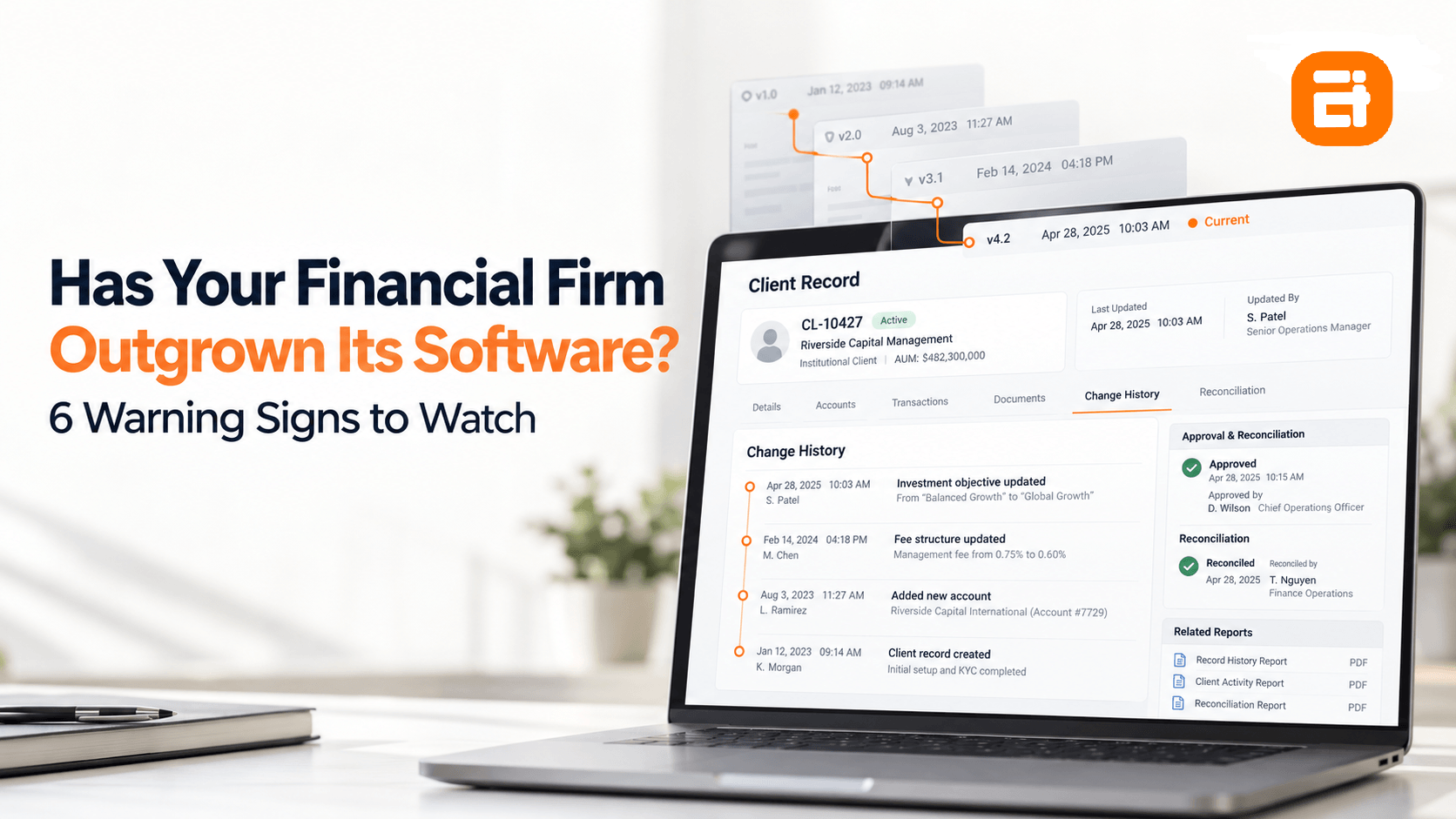
Sign 2: You Cannot Show Who Changed What, and When
A system has a serious history gap when it shows the current value but cannot reliably show what changed, who changed it, and when.
Many general business applications are designed primarily around the current state. A user edits a field, the new value becomes visible, and daily work continues.
Financial operations can require a different level of traceability. If an amount, status, approval, classification, or client record changes, the previous state still matter later.
An audit trail therefore needs more than a timestamp showing that somebody edited a record. It should preserve enough context to reconstruct the sequence of material changes.
Check whether existing audit settings can capture the required changes from now on. That prevent future gaps, but it cannot restore evidence that was never recorded.
Sign 3: Client Onboarding Runs on Email and Attachments
Client onboarding has outgrown the system when documents, approvals, checks, and status depend on inboxes and folders instead of one controlled workflow.
One employee receive a document by email, another records information elsewhere, and an approval remain inside a message thread.
The next person then has to determine what has happened before continuing.
The immediate cost is onboarding time. Employees spend more of it locating attachments, checking status, requesting missing information, and confirming who completed the previous step.
A client onboarding workflow should make the sequence visible without relying on individual memory.
If your existing platform already supports configurable documents, approval stages, permissions, and status tracking, use those capabilities before commissioning a new system.
Sign 4: Regulatory Reports Are Assembled by Hand
Manual regulatory reporting becomes a software-fit problem when every reporting period requires the same data to be exported, checked, reshaped, and rebuilt.
The data come from a core platform, transaction system, spreadsheet, client database, or another operational source.
Staff then combine it into the required reporting structure and manually investigate anything that does not agree with the source data.
Once submitted, the process starts again during the next reporting period because the assembly logic itself was never captured in software.
The concern is not simply the number of spreadsheets involved. It is that the relationship between the source data, corrections, calculations, and final report depends on repeated human reconstruction.
AITC addressed a similar reporting challenge when developing AITC Homes, where billing history and management reporting remain connected inside one property system rather than across disconnected files.
For a financial firm, the same principle applies recurring reports are easier to reproduce when they come from structured operational data instead of being reconstructed manually each period.
If exporting data has become the reporting process itself, see When Exporting to Excel Becomes Your Reporting System.
Sign 5: The Core System Makes Integration Difficult
A core system becomes the bottleneck when it cannot exchange reliable data with the applications that need to operate around it.
A ledger, banking platform, or legacy system still perform its primary function correctly while offering limited API integration or difficult data access. Information then moves through exports, scheduled files, or manual re-entry.
Every additional tool inherits that limitation. An onboarding platform need one workaround, a reporting system another, and a reconciliation process another.
The result is a growing collection of manual bridges around a core system that was never designed to connect with them.
Before replacing it, determine whether a middleware or integration layer can solve the problem. Core banking integration does not automatically require replacing the underlying platform.
Sign 6: Every Client Wants Their Own Report
Client reporting has outgrown standard templates when important clients repeatedly require different periods, measures, calculations, formats, or presentation structures.
A standard reporting tool works well when most clients can consume broadly the same output. The problem changes when employees must export the same source data and rebuild a different report for each relationship.
Once the same reconstruction happens every cycle, the reporting template is no longer the real issue.
The system lacks a reusable reporting model capable of applying different rules to the same underlying data.
Configuration should still be tested first. If the platform has a capable report builder, the problem is already be solvable.
The Data Requirement That Can Change the Decision
The requirement that often changes the decision is reconstructable history: financial firms need to understand not only what is true now, but what was true earlier and how it changed.
Current State Versus Immutable History
The key architectural difference is whether the system preserves material changes as history instead of keeping only the latest operational state.
A system designed mainly around the current state can replace or update values as work progresses.
A traceable model instead retains versions or appends new events so earlier states remain available.
That history can include the previous value, new value, user, timestamp, approval, reason, or related transaction where appropriate.
This is fundamentally a data-model decision. You can add a new screen or report later, but history that was never captured cannot be reliably recreated by switching on an audit log afterwards.
That is why an audit trail software requirement should be identified before development or migration begins.
What You Need to Be Able to Reconstruct
A suitable system need to reconstruct past positions, decisions, communications, and source data without relying on somebody's memory.
Depending on the business and jurisdiction, that can include:
- Past account or position state: What the account or position looked like at an earlier date.
- Approval history: Who approved a transaction, change, or exception, and when.
- Client communication record: What information was presented or communicated to the client at that time.
- Onboarding records: What identification information and checks were recorded during onboarding.
- Report calculation trail: How a figure included in a submitted report was derived
The exact retention, access-control, identification, reporting, and auditability obligations differ by jurisdiction and should be confirmed locally.
From our delivery work
When teams try to reconstruct an earlier position, the difficulty is often not finding the latest record. It is recovering the sequence behind it, which value changed, where the change was recorded, who approved it, and whether the supporting context still exists. When that history sits across spreadsheets, messages, and separate systems, some of it is no longer be reconstructable from the main platform alone
What Custom Financial Software Costs
The useful cost comparison is not the development quote alone; it is the current operating cost versus the long-term cost of building and supporting the missing capability.
Start with current licenses and add the staff time spent reconciling records, managing onboarding exceptions, assembling recurring reports, and rebuilding client outputs.
Compare that with development, integration, migration, testing, hosting, maintenance, and ongoing support over the system's expected life.
Integration with an inflexible core platform can become a major scoping variable because every surrounding workflow depends on how reliably that system exposes data.
AITC's discovery work has shown that recurring reporting can cost more operational time than teams initially expect once the hours spent assembling, checking, correcting, and reformatting each cycle are counted.
That hidden workload should be included when comparing the current system with the cost of building and supporting a custom layer.
Our guide to software development costs explains the broader factors that shape a custom build.
A sensible first scope is usually narrower than replacing the core system. Custom fintech software development can start with the layer creating the operational problem, such as reconciliation, client onboarding, approval workflows, or reporting.
The existing ledger or platform can remain in place while the custom layer exchanges data with it.
This reduces the number of assumptions being changed at once and lets the firm solve the specific limitation that justified development.
Start with one question about the past
A 30-minute process review—we test what your systems can reconstruct and what that means for the decision.
When a Financial Firm Should Not Build
A financial firm should not build custom software when its existing platform can preserve the required history and support the workflow through configuration or integration.
- Your platform already keeps sufficient history: Check its change history, audit trail, export capability, and reporting features before assuming a new system is necessary.
- You have not enabled the workflow capabilities you already pay for: Existing approval stages, permissions, logs, automation, or reporting tools solve the problem.
- The volume does not justify development: Count the reconciliation, onboarding, and reporting hours before turning a manageable manual process into a software project.
- Nobody senior will own the system: A custom platform encodes decisions about authority, approvals, exceptions, and priorities, so somebody inside the firm must own those decisions.
- A short deadline is driving the decision: If the immediate need arrives before a responsible custom build can be delivered, solve the urgent problem another way first.
If the wider question is whether your organization is ready to own software at all, use the Custom Software Readiness Test .
What to Do Before You Replace Core Systems
Before replacing a core system, test what your existing stack can reconstruct, export, and support so the decision is based on evidence rather than frustration.
- Run the reconstruction test: Select one closed period and recreate the position as it stood, including the material changes and approvals that produced it. Anything important you cannot reproduce becomes a requirement to investigate.
- Count one reporting cycle: Record the hours spent exporting, combining, checking, correcting, approving, and formatting recurring reports.
- Ask your platform vendor two precise questions: Does the platform retain complete change history for the records that matter, and can that history be exported in usable form?
- Map onboarding end to end: Document every handoff, attachment, decision, approval, exception, and status change, including the steps currently completed through email.
These checks use records and vendor information you already have and can be completed before making any development commitment.
Deciding Whether Custom Financial Software Is Worth It
Custom software for financial services is worth considering when essential history, workflows, reporting, or integrations cannot be represented reliably by the system you already use.
For financial firms, the decision is therefore rarely about adding another feature. A missing screen can often be configured or added.
A system that never captured historical changes, cannot represent the approval sequence, or cannot exchange usable data presents a deeper architectural problem.
If the case is not strong today, reassess when a reporting period cannot be reproduced; important client reporting repeatedly requires reconstruction, or a material approval cannot be traced.
Those events show where the limitation is moving from inconvenience into operational dependency.
In many businesses, the wrong software mainly wastes time. In financial operations, it can also leave the organization unable to reconstruct a past decision, record, or reporting position when that information is needed.
Need Help Deciding What to Build?
If your financial workflows are becoming difficult to reconcile, trace, integrate, or report, discuss the problem with our team before committing to a new system.
FAQs
1. What Is Custom Software for Financial Services?
Custom software for financial services is a system designed around a firm's specific operational workflows, data relationships, integrations, approvals, reporting, and record-history requirements.
2. How Much Does Custom Financial Software Cost?
Custom financial software has no fixed price because cost depends on scope, integrations, migration, workflows, reporting complexity, testing, security requirements, and ongoing support.
3. Can Custom Software Integrate with Our Existing Core System?
Custom software can integrate with an existing core system when that system provides a reliable API, export mechanism, database interface, or another controlled method of exchanging data.
4. How Long Does It Take to Build Custom Software for a Financial Firm?
Development time depends on scope, integrations, data migration, workflow complexity, testing, security requirements, and how easily existing core systems expose the required data.
5. What Is an Audit Trail and Why Does It Matter in Financial Software?
An audit trail is a history of material record changes and actions that helps a firm reconstruct what changed, when it changed, and who performed or approved it.
6. Is Custom Software Worth It for a Small Financial Services Firm?
Custom software can be worthwhile for a small financial firm when a stable, important workflow has structural requirements that configuration or existing products cannot support reliably.

Related insights

The Rise of Virtual and Augmented Reality (VR/AR) in Business
21 Nov 2025

Choosing the Right E-Commerce Platform for Your Nepal-Based Business
21 Nov 2025
The Evolution of Software Development: A Journey Through Time
19 Dec 2025
Have a project in mind? Let's build something great.
Share your ideas or questions and our experts will get back to you shortly.
Unlock Expert Guidance
Need expert IT advice? Our seasoned professionals are here to help you navigate your tech challenges. Schedule a session with us and get personalized solutions tailored to your business needs.

Connect with Us and Let's Build Something Together
We'd love to hear from you! Whether you have questions, need support, or want to discuss a new project, our team is ready to assist. Fill out the form below, and we’ll get back to you as soon as possible.
Prefer a Direct Consultation?
Connect with our team for a 1-on-1 virtual session to discuss your project, understand your needs, and explore the right solution for your business.
What's Next?
- 1Connect with you at a convenient time
- 2Explore your needs, goals, and requirements
- 3Prepare a tailored proposal based on your needs
Why Choose Us
Connect with AITC
Select your inquiry type to route your request to the right department.
Our Office Locations
Operating across 3 key timezone hubs to serve global enterprise clients.