







Software
Custom
Custom Software for Startups: Deciding What to Build or Buy

sachin pokharel
26 Oct 2026
Founders asking should a startup build custom software are usually asking two different questions.
Is the software the thing customers pay for, or is it software the team uses to run the company? The first often requires building, while the second usually starts with buying.
That distinction matters because advice about custom software development for startups often mixes product engineering with internal tooling.
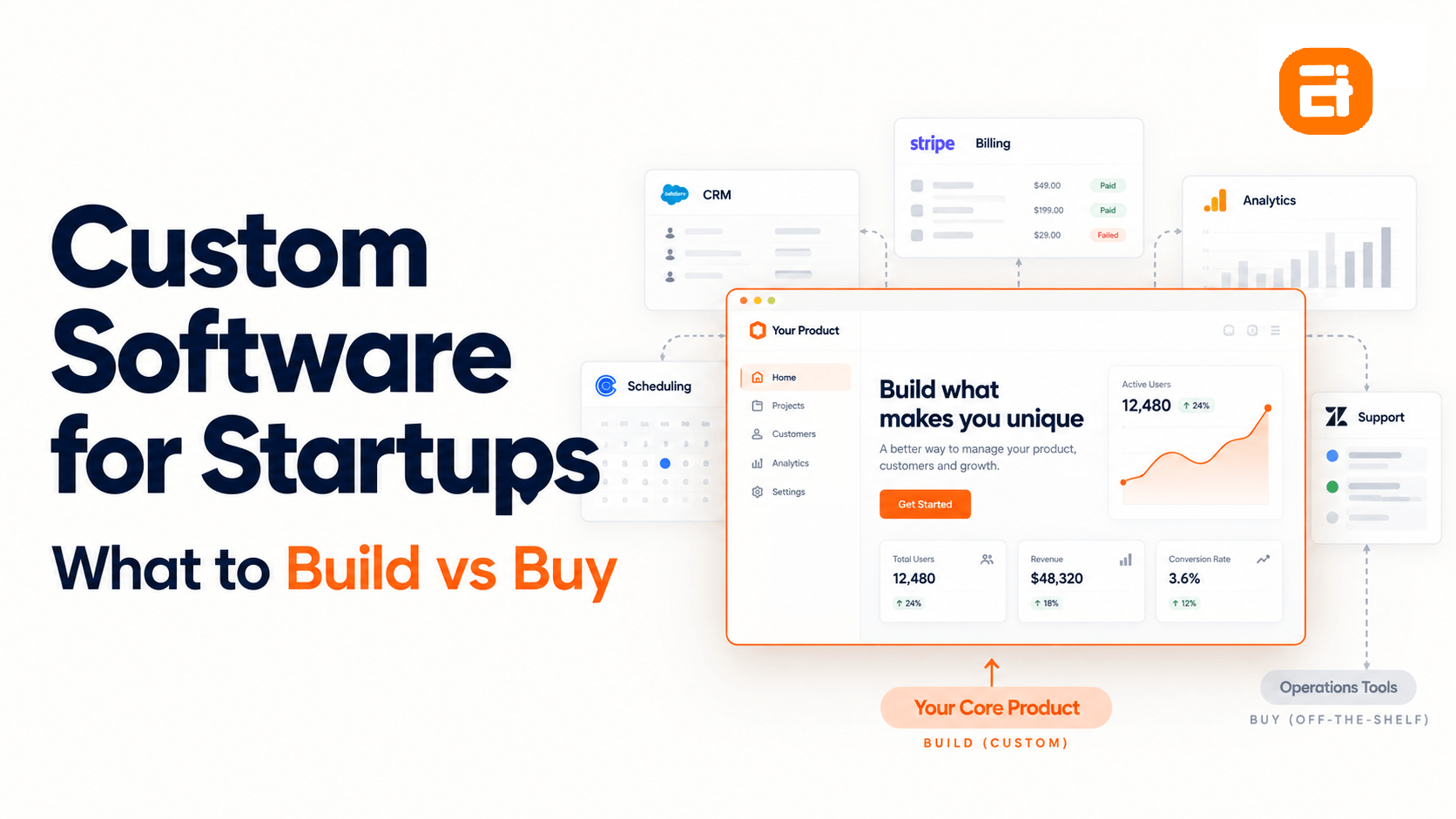
A startup can need proprietary product software while still buying its CRM, billing, analytics, support, scheduling, and collaboration tools.
In this blog, we separate those decisions, show how the answer changes by stage, and explain when an internal build has earned a place on the roadmap.
Key Highlights
- Build the parts customers pay for when they create the product's real differentiator.
- Buy or configure internal software first unless a stable, repeated process has clearly outgrown standard tools.
- Before product-market fit, manual work and no-code tools can preserve learning while requirements are still changing.
- After traction, repeated manual steps and persistent integration gaps become stronger candidates for focused custom development.
- Count engineering opportunity cost and the maintenance burden alongside subscriptions when comparing startup software costs.
Product Software vs. Internal Business Systems
The build-vs-buy startup software decision changes completely depending on whether the software creates customer value or only supports company operations.
Treating those two categories as one decision is how scarce engineering time gets spent on the wrong problem.
When the Software Is the Business
When customers pay for the software itself, building the differentiated part is not optional because that capability is the product.
The narrower question is how much must exist before customers can use it, pay for it, or prove that the problem matters.
That does not mean every layer should be custom. A startup can buy hosting, authentication, payments, communications, analytics, monitoring, and other commodity infrastructure.
This keeps engineering focused on the workflow, data model, or experience customers actually value.
Y Combinator's MVP guidance emphasizes launching a small version, talking to users, and learning from real usage rather than treating the first release as the finished product.
The distinction between an MVP vs custom software therefore matters: an MVP is a scope decision about evidence, while custom development describes who owns the software being built.
When the Software Only Supports the Business
When software supports internal operations, the default should usually be buy, configure, integrate, or tolerate an imperfect fit before building.
That includes sales tracking, onboarding, reporting, scheduling, and billing.
The reason is ownership cost. An internal tool does not end when it launches; it creates testing, support, security, upgrades, integration work, and future changes.
Those obligations arrive when a startup's founding engineer or small technical team is already competing against the customer-facing roadmap for time.
Use standard software where the process is standard. If the product mostly fits but needs configuration or one missing connection, test that gap before commissioning a build.
The broader off-the-shelf vs custom software guide explains how.
What Startups Should Build at Each Stage
The same software request can be sensible at one stage and premature at another.
So when should a startup build software? When the product or process is understood well enough to justify ownership.
Before Product-Market Fit
Before product-market fit, preserve learning and avoid turning assumptions into permanent systems.
Build only the part that is genuinely the product and only as far as the next useful proof requires.
Manual work is valuable here because it exposes how the process actually works, including exceptions that may not be obvious at first.
A proof of concept, spreadsheet, no-code workflow, or manual service can therefore be the correct technical choice when the rules are still moving.
Writing software too early also consumes feedback time and makes a pivot more expensive. Preserve runway until the company has stronger evidence.
After Early Traction
After early traction, the first credible build candidates are repeated problems the team already understands.
Look for a manual process that happens many times a day, an integration gap that requires repeated re-entry, or a recurring report that one person rebuilds every week.
The useful test is history, not prediction. Build the workflow you have performed manually long enough to understand its rules, exceptions, ownership, and failure points.
A lightweight automation that removes one repeated handoff may create more value than replacing the whole stack.
At Scale
At scale, custom internal software becomes easier to justify because the economics and ownership model change.
Per-seat pricing can become material, stable processes may reflect how the company actually competes, and the engineering organization may have capacity to maintain what it builds.
The differentiator matters more than the company size alone. Generic processes usually remain poor ownership candidates; a proprietary workflow may deserve it when standard products cannot represent the rules.
At this point, startup tech stack decisions become an organizational-readiness question requiring a named owner, stable process, integration access, and maintenance plan.
Limitations of Off-the-Shelf Software for Startups
Off-the-shelf tools for startups become a build question only when configuration, packaging, or integration cannot reasonably solve a structural constraint.
Four limitations deserve a closer look:
- Pricing grows faster than useful adoption: Per-seat or tiered pricing may become inefficient. Renegotiating plans or reducing unused seats should come before rebuilding the product.
- Tools cannot exchange the data the workflow needs: If employees repeatedly export, copy, or re-enter information, test whether an integration can remove the handoff before replacing either system.
- The product assumes a workflow your company does not use: A real fit problem exists when the tool's underlying process conflicts with a stable way your business must operate.
- Your data is difficult to retrieve or migrate: Weak export options and proprietary formats can create vendor lock-in. Check portability before the tool becomes critical.
When the main problem is that several systems do not exchange data, the disconnected systems guide covers integration and shared-data options without assuming a full custom replacement.
Custom Software Cost Considerations for Early-Stage Companies
Startup software costs should include opportunity cost, not just development cost.
Engineering time spent on an internal system is time taken away from the product roadmap, while every custom build also creates an ongoing maintenance responsibility.
Compare that commitment with the cost of subscriptions, manual work, and integration problems.
Our software development cost guide explains the broader factors that affect long-term ownership.
For an early-stage company, the better starting point is usually the smallest build that removes one repeated, well-understood manual step, rather than replacing an entire system.
In AITC discovery conversations, a broad request for an internal system can become much smaller once the underlying workflow is mapped.
The useful first scope is often the repeated manual step causing the problem, rather than every process surrounding it.
The final question is whether owning the software is a better use of limited engineering capacity than buying, configuring, or integrating an existing tool.
Build when the process is stable and the value justifies maintaining it.
Find the Smallest Thing Worth Building
A short consultation can examine the repeated manual step costing your team the most and test whether it is stable enough to automate.
When a Startup Should Not Build Custom Software
A startup should not build internal software when the process, ownership, or business case is still too uncertain to justify a permanent maintenance obligation.
Delay the build when any of these conditions applies:
- The process still changes every month: Coding it now would encode a draft and turn normal learning into rework.
- Nobody has run the process manually: If the team has not performed the workflow, it probably does not know the real rules or exceptions yet.
- The current tool has not been configured properly: Test workflows, roles, automations, APIs, and available modules before concluding the product cannot fit.
- There is no internal owner: If nobody can prioritize changes, test releases, and maintain decisions after launch, the system has nowhere to live.
- Runway is too short for the bet: If the build competes with the product or extends beyond the period the company can responsibly fund, preserve flexibility instead.
When founders ask what should a startup build in house, prioritize customer value or a stable internal process that standard tools cannot support.
For the broader ownership question, use the custom software readiness test.
Assessing Your Technology Stack Before Building
Tool count alone is not a startup build trigger; assess repeated work, stable rules, and ownership instead.
In Stack Overflow's 2025 Developer Survey, 54% of 27,378 respondents to the tool-count question used six or more applications or platforms at work.
Use these four checks before adding another system:
- List every tool and the job it performs: Record the recurring cost, owner, data it holds, and what would stop if the tool disappeared tomorrow.
- Find the repeated manual step: Measure how often it happens, how much time it consumes, where it fails, and whether the rules are written down.
- Check whether the rules have stayed stable: If the workflow has changed materially during the last few months, keep learning before turning it into software.
- Name the maintenance owner: Identify who will answer questions, approve changes, test releases, and spend time on the system after the development project ends.
How to Decide What a Startup Should Build
Decide what to build by separating the product from the plumbing and then applying the stage test.
Product work must prove customer value; internal work must earn engineering time against the roadmap every time.
If the answer is buy today, define what would change it. Reconsider when a manual process becomes stable, two critical tools cannot be integrated responsibly, or an internal workflow becomes part of the customer experience.
Those are stronger signals that ownership may create strategic value.
Even then, early-stage companies rarely need to control every system they use.
The goal is to own the software that creates strategic value while keeping everything else replaceable enough to preserve runway, speed, and the ability to change direction.
Not Sure What Is Worth Building Yet?
A product discovery workshop can separate the product from the plumbing, test the riskiest assumptions, and define the smallest build worth committing to.
FAQs
1. Should a startup build custom software or use off-the-shelf tools?
A startup should build customer-facing differentiation and buy internal tools first unless a stable, important workflow clearly cannot fit available software.
2. When is a startup ready to build internal software?
A startup is ready when the process is stable, repeated, measurable, poorly served by existing tools, and has a named owner for ongoing maintenance.
3. What is the difference between building a product and building internal tools?
Product software creates the customer value the company sells, while internal tools support operations and must justify their opportunity cost against product work.
4. How much should an early-stage company spend on custom software?
There is no responsible universal amount; compare the build and maintenance burden with subscriptions, manual work, integration friction, runway, and foregone roadmap work.
5. Is no-code a real alternative for startups?
Yes, no-code can be useful for a proof of concept or changing internal workflow when its integration, data, security, and portability limits remain acceptable.
6. What should a startup never build in-house?
A startup should avoid rebuilding commodity software that creates no customer differentiation when a suitable maintained product already solves the requirement.
Related insights

The Rise of Virtual and Augmented Reality (VR/AR) in Business
21 Nov 2025

Choosing the Right E-Commerce Platform for Your Nepal-Based Business
21 Nov 2025

The Evolution of Software Development: A Journey Through Time
19 Dec 2025
Have a project in mind? Let's build something great.
Share your ideas or questions and our experts will get back to you shortly.
Unlock Expert Guidance
Need expert IT advice? Our seasoned professionals are here to help you navigate your tech challenges. Schedule a session with us and get personalized solutions tailored to your business needs.

Connect with Us and Let's Build Something Together
We'd love to hear from you! Whether you have questions, need support, or want to discuss a new project, our team is ready to assist. Fill out the form below, and we’ll get back to you as soon as possible.
Prefer a Direct Consultation?
Connect with our team for a 1-on-1 virtual session to discuss your project, understand your needs, and explore the right solution for your business.
What's Next?
- 1Connect with you at a convenient time
- 2Explore your needs, goals, and requirements
- 3Prepare a tailored proposal based on your needs
Why Choose Us
Connect with AITC
Select your inquiry type to route your request to the right department.
Our Office Locations
Operating across 3 key timezone hubs to serve global enterprise clients.