







DevOps
Agile and Devops Explained: Key Concepts, Tools, and Trends


19 Dec 2025
Today, businesses need fast, reliable, and error-free software. Traditional software testing methods are often slow and cannot keep pace with modern software development.
This is where Agile methodology and DevOps practices came. These modern approaches helped software development and testing run faster, smoother, and more collaboratively.
Agile works in short development cycles called sprints, allowing teams adapt to changes and deliver updates faster.
DevOps bridges the gap between software development and IT operations, enabling continuous integration and continuous delivery (CI/CD) so that software can be released efficiently.
When Agile and DevOps are combined, software testing becomes continuous instead of happening only at the end. This helps teams find bugs early, improve software quality, and speed up releases.
Understanding Agile, DevOps, CI/CD, and software testing helps companies build better enterprise applications, save time, and stay competitive in today’s fast-moving technology market.
Understanding Agile and DevOps: A Brief Overview
Agile methodology
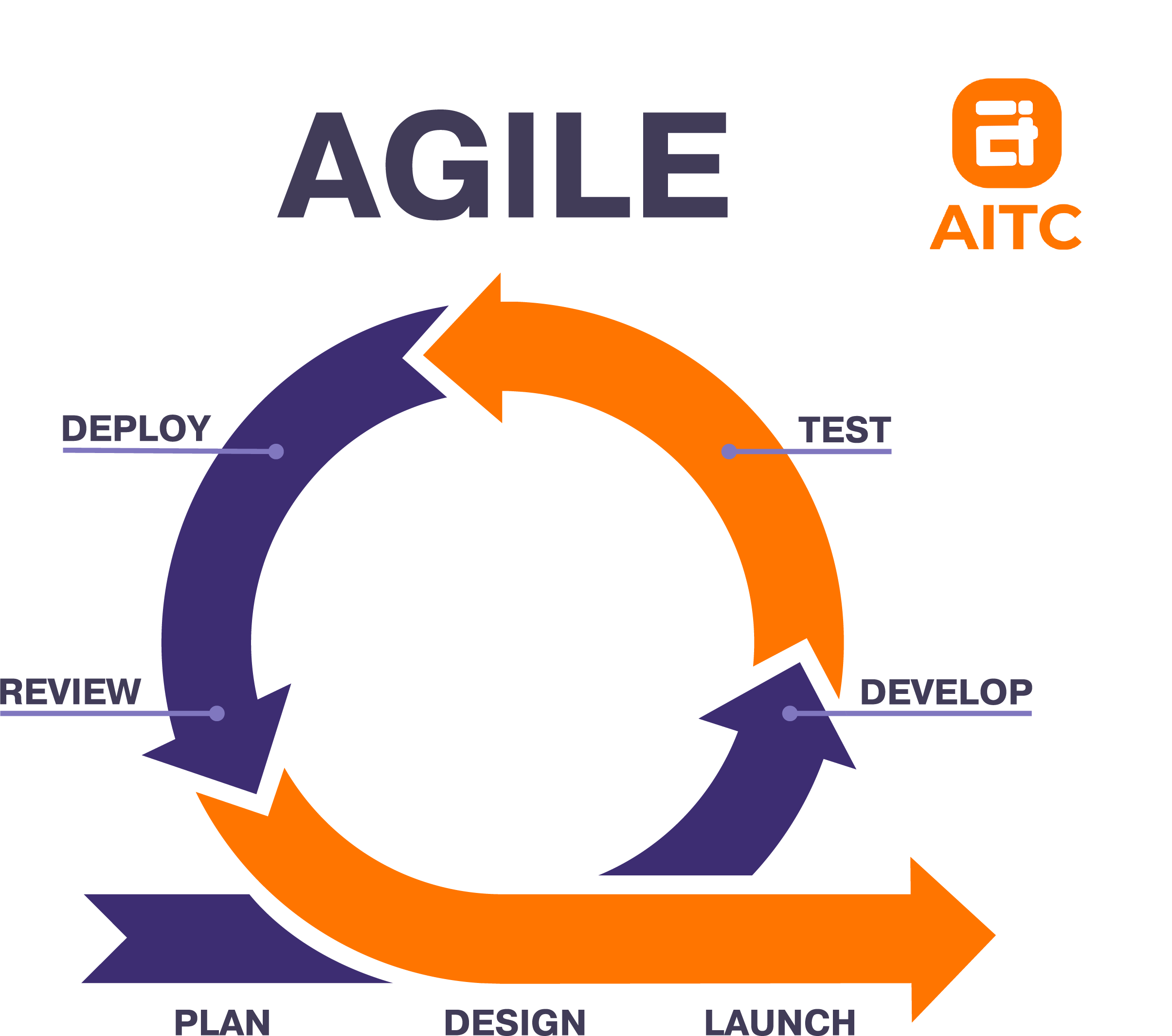
Agile is a software development methodology that creates software in small parts instead of building everything at once. It focuses on flexibility, teamwork, customer feedback, and continuous improvement.
Agile helps teams respond to changes and deliver high-quality software faster.
And agile software development methodology focused on the following Methods:
Iterative and Incremental Delivery
- Software is developed in small cycles called iterations.
- Each cycle adds a new feature to the software.
Continuous Feedback
- Feedback is taken regularly from customers and users.
- This helps improve the product.
Collaboration Between Cross-Functional Teams
- Developers, testers, and designers work together.
- Teamwork improves speed and quality.
Responding to Change
- Agile allows changes anytime, even late in development.
- It values change more than following a fixed plan.
Agile Frameworks
Frameworks are structured ways to apply Agile principles.
Scrum
- Uses short work cycles called Sprints (1–2 weeks).
- Teams meet daily to discuss progress.
Kanban
- Uses a Kanban Board to show work status.
- Helps manage and visualize tasks easily.
XP (Extreme Programming)
- Focuses on writing clean code, testing, and teamwork.
- Ensures high software quality.
DevOps
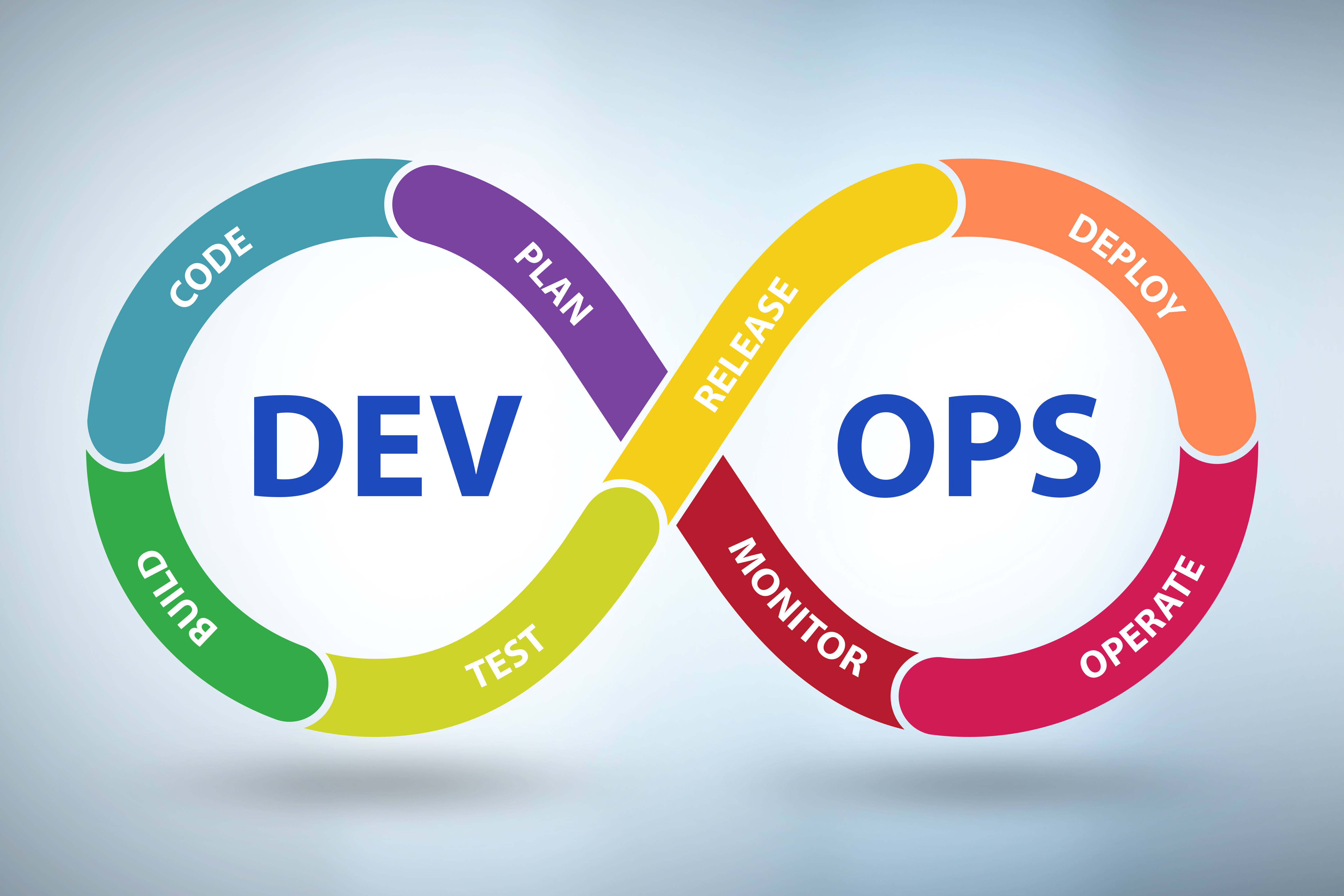
DevOps is a set of practices and a working culture where Software Development (Dev) and IT Operations (Ops) teams work together.
The main goal of DevOps is to deliver software faster, safer, and more reliably using automation and team collaboration.
Key Concepts in DevOps
CI/CD (Continuous Integration & Continuous Delivery)
- Continuous Integration (CI):
Developers regularly add code to a shared system. - Continuous Delivery (CD):
Software is automatically tested and prepared for release.
This helps in quick and error-free releases.
Infrastructure as Code (IaC)
- Servers and system setup are written as code.
- Tools like Terraform and AWS CloudFormation help do this.
- It makes infrastructure easy to create, update, and manage.
Monitoring and Observability
- Tools like Prometheus, Grafana, and CloudWatch keep watch on software.
- Problems are detected early and fixed quickly.
Automation Across SDLC
- SDLC (Software Development Life Cycle) includes planning, coding, testing, and deployment.
- DevOps automates tasks like build, test, and deploy.
- Automation reduces human errors and saves time.
2. The Role of Testing in Agile and DevOps
In Agile and DevOps, testing is a continuous process that happens throughout the entire development lifecycle, not just at the end. This change enhances teams' thinking about software quality.
Instead of treating testing as a final step or gate, it becomes a team activity done from the beginning. Developers, QA testers, and product owners all test software from an early stage, helping to find and fix problems quickly and build better, more reliable software.
Traditional Testing vs Agile/DevOps Testing
| Feature | Traditional Testing | Agile/DevOps Testing |
| When Testing Occurs | After development | Throughout development |
| Responsibility | QA team | Whole team (shift-left) |
| Test Design | After requirements freeze | Concurrent with development |
| Feedback Cycle | Slow | Fast and continuous |
| Tools | Manual-heavy | Automated and integrated |
3. Key Agile Testing Practices
Agile testing follows the simple idea: “test early, test often, test continuously.”
This means testing starts from the beginning of the SDLC and continues at every step to make sure the software quality remains high.
Agile testing uses practices like Test-Driven Development (TDD), test automation, and close collaboration between developers and testers (QA) to find defects quickly and fix them early.
Test-Driven Development (TDD)
- Tests are written before the actual code.
- This ensures the code meets requirements, works correctly, and is easy to test.
Behavior-Driven Development (BDD)
- Focuses on user behavior and how the software is used.
- Tools like Cucumber and SpecFlow describe features in simple, readable language.
- Improves collaboration between QA teams, developers, and business stakeholders.
Acceptance Test-Driven Development (ATDD)
- Customers, developers, and testers work together to define acceptance criteria.
- Ensures the final product aligns with business goals and user expectations.
Exploratory Testing
- Testing, learning, and execution happen simultaneously.
- Helps testers discover unexpected issues that automated tests may miss.
4. Integrating DevOps into Testing
DevOps enhances testing by adding automatic tests directly into the Continuous Integration (CI) and Continuous Delivery (CD) pipeline. This means the software is tested continuously as it is being built to find problems early, get feedback faster, and ensure that software releases are smooth and reliable.
Continuous Integration (CI)
In Continuous Integration, developers regularly add their code to a shared code storage (repository).
Every time new code is added, the system automatically builds and tests the software.
This helps find bugs early and often, before they become big problems.
Popular CI Tools are:
- Jenkins
- GitLab CI
- Azure DevOps
- CircleCI
Benefits of Continuous integration in DevOps:
- Rapid feedback on code quality.
- Early bug detection through automated tests.
- Reduced integration issues when combining code from multiple developers.
Continuous Delivery (CD)
Continuous Deployment (CD) is an important part of DevOps.
In CD, when developers push code to tools like GitHub, it is automatically tested and deployed to environments such as staging or production.
Automation tools like Jenkins, GitHub Actions, or GitLab CI/CD help move the code forward without manual effort. This process helps software teams release updates faster, safer, and more frequently.
Testing Types Integrated into CD Pipelines
Unit Testing
Unit testing checks small pieces of code, such as a single function or class, to make sure they work properly. Developers usually write these tests using tools like JUnit or PyTest.
Integration Testing
Integration testing ensures that different modules of the application work together, such as the connection between the user interface and the database.
API Testing
API testing checks backend services and how different systems communicate with each other using APIs. Tools like Postman are often used for this.
Performance Testing
Performance testing measures how well an application performs under heavy usage. It checks speed, stability, and response time, especially when many users access the system at once.
Security Testing
Security testing helps find security risks and weaknesses before the software goes live. It protects applications from hackers and data theft by identifying vulnerabilities early.
Continuous Testing
Continuous Testing refers to executing automated tests at every stage of the software delivery pipeline—not just after code is written. It ensures that quality gates are met consistently and that every release is reliable, secure, and performant.
Key Advantages:
- Reduces manual testing overhead
- Builds confidence in rapid releases
- Identifies issues before they impact users
5. Tools That Empower Agile and DevOps Testing
Modern testing relies on powerful tools that support automation, collaboration, and continuous integration. The right testing toolchain not only accelerates development but also ensures consistent quality at every stage of development.
| Category | Description | Tools |
| Test Management | help organize and track test cases, plans, and execution | Jira, TestRail, Zephyr, PractiTest |
| Automation Frameworks | ensure faster and more reliable test coverage. | Selenium, Cypress, Playwright, Appium, Robot Framework |
| CI/CD | enable seamless integration and deployment with continuous testing built in. | Jenkins, GitHub Actions, Azure DevOps, GitLab CI |
| BDD | align tests with user behavior and business requirements | Cucumber, SpecFlow, Behave |
| Performance Testing | ensure apps run smoothly | JMeter, k6, Gatling, Locust |
| API Testing | ensure apps run securely under load. | Postman, Rest Assured, Karate, SoapUI |
| Security Testing | uncover vulnerabilities before release. | OWASP ZAP, Burp Suite, Snyk |
| Monitoring & Logging | provide real-time visibility into performance and health post-deployment. | Prometheus, Grafana, ELK Stack, Datadog |
Using the right mix of these tools allows teams to build, test, and release with confidence and speed.
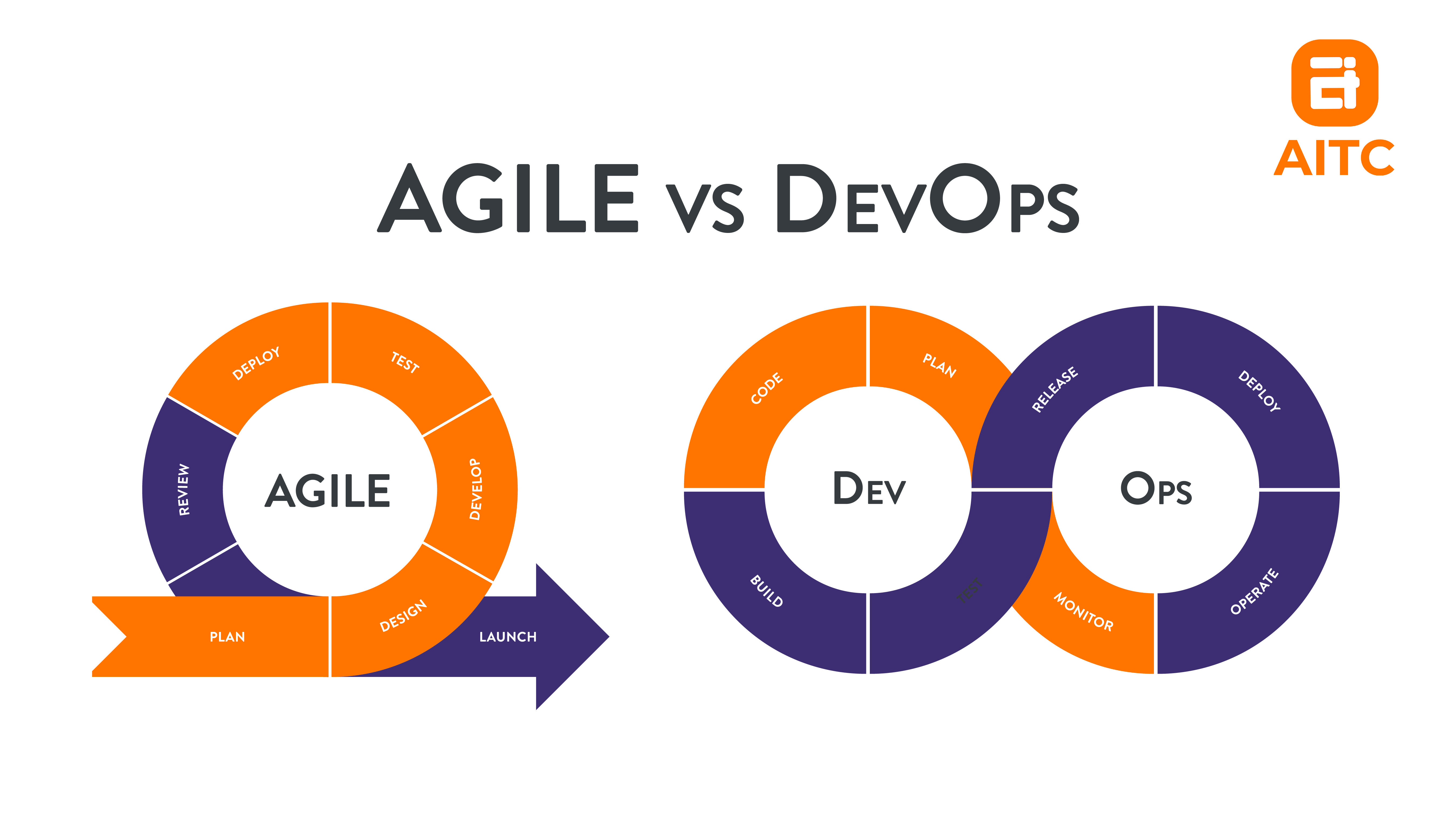
6. Key Differences Between DevOps and Agile Methodology
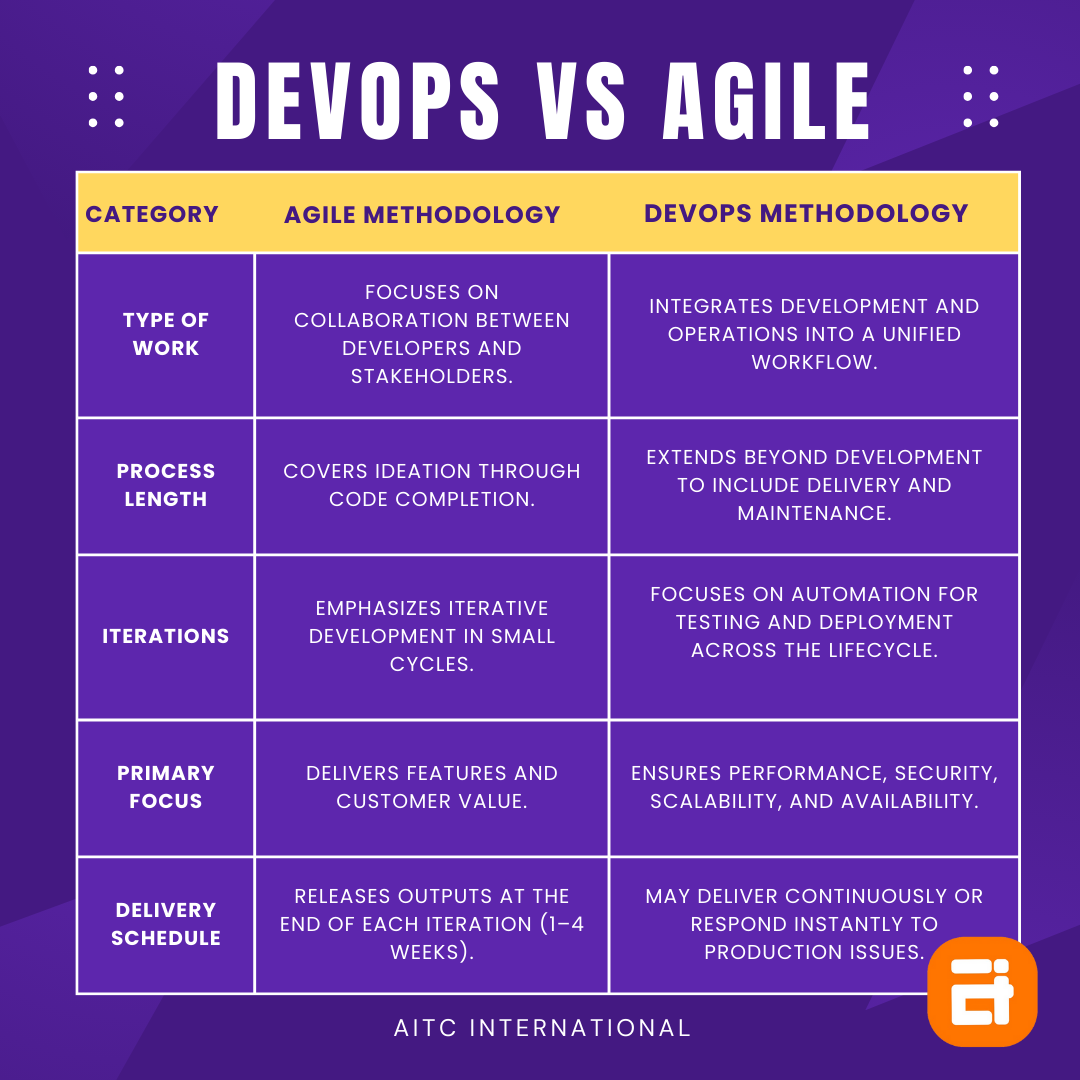
While Agile and DevOps share the goal of delivering high-quality software efficiently, they approach it from different perspectives. Understanding their distinctions helps teams apply each methodology where it fits best:
Type of Work:
Agile emphasizes collaboration between developers and stakeholders but traditionally excludes operations. DevOps, by contrast, fully integrates operations into the development cycle.
Process Length:
Agile primarily focuses on the development stages—from ideation to code completion. DevOps extends beyond development to include delivery, deployment, and maintenance.
Iterations:
Agile promotes iterative development in small, manageable cycles. DevOps centers on automation, particularly for testing, deployment, and infrastructure management.
Focus:
Agile is focused on delivering customer-facing features and functionality. DevOps emphasizes the broader operational concerns such as system performance, security, scalability, and availability.
Delivery Schedule:
Agile teams typically deliver at the end of each iteration (usually 1–4 weeks). DevOps teams may work on scheduled releases or respond immediately to critical issues, such as downtime or bugs in production.
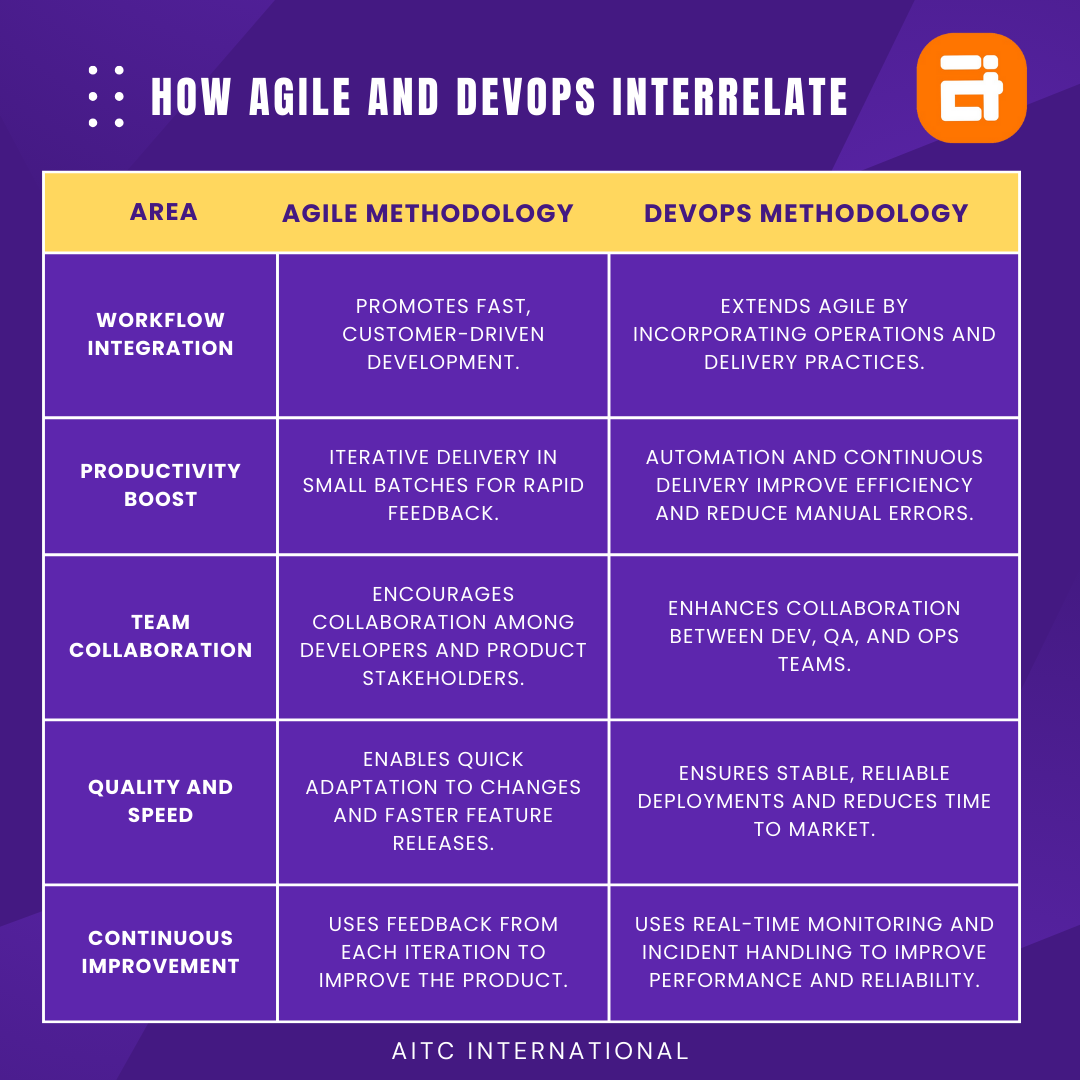
7. How Do Agile and DevOps Interrelate?
A common misconception is that Agile and DevOps are competing in methodologies. In reality, they complement each other and, when combined, provide a holistic approach to software development and delivery.
1. Integrating Operations into Agile Workflows
Agile focuses on developing features and responding quickly to user needs. However, it traditionally omits operations. DevOps fills this gap by bringing operational awareness into the development process. Together, they form a unified approach that improves delivery speed, software quality, and team alignment.
DevOps can be seen as the natural evolution of Agile adopting its iterative principles while adding automation, deployment, and operational monitoring into the mix.
2. Increasing Productivity Across the Pipeline
Agile encourages working in small, valuable increments. DevOps brings in automation for testing, integration, and delivery. By combining these approaches, teams achieve:
- Faster, more reliable deployments
- Streamlined collaboration between development and operations
- Continuous improvement in both development speed and operational stability
For example, Agile helps prioritize the most impactful features, while DevOps ensures those features are tested, deployed, and monitored efficiently. This leads to higher productivity, fewer errors, and quicker feedback—resulting in better experiences for both developers and end users.
8. Shift-Left and Shift-Right Testing
️ Shift-Left
Shift-left testing moves testing to earlier stages of the development process—such as during unit, API, or integration stages—rather than waiting until after development is complete.
Key Benefits:
- Detects and prevents bugs earlier
- Speeds up feedback cycles
- Reduces the cost and complexity of fixing defects
- Encourages developer ownership of quality
By catching issues early, teams improve stability and reduce the time spent on late-stage rework.
Shift-Right
Shift-right testing focuses on validating software in real-world production environments. It includes techniques like monitoring, canary releases, A/B testing, and chaos engineering.
Key Benefits:
- Provides insights based on real user behavior
- Enhances reliability and scalability
- Identifies issues that may not surface in pre-production
- Enables continuous improvement through data and observability
This approach helps ensure that software performs well not just in the lab, but in the real world—where it matters most.
9. Metrics That Matter in Agile/DevOps Testing
In Agile and DevOps, measurement isn’t optional—it’s essential. Tracking the right metrics helps teams gauge performance, identify bottlenecks, and improve the speed and quality of software releases. These key DevOps and Agile testing metrics empower continuous improvement through actionable insights.
| Metric | Description |
| Test Coverage | Percentage of code covered by automated or manual tests. |
| Mean Time to Detect (MTTD) | Average time taken to identify issues or incidents. |
| Mean Time to Repair (MTTR) | Time taken to resolve and fix detected issues. |
| Deployment Frequency | How frequently new code is deployed to production. |
| Lead Time for Changes | Time from code commit to production |
| Defect Escape Rate | Number or rate of bugs found after the release. |
| Automation Rate | Percentage of test cases that are automated. |
10. Challenges in Agile/DevOps Testing
While Agile and DevOps testing offer significant advantages, they also present unique challenges that teams must navigate to succeed:
- Rapid Release Cycles: Accelerated development and deployment speeds put pressure on testing to keep pace without compromising quality.
- Test Automation Debt: Over time, flaky or outdated automated tests can accumulate, slowing down CI/CD pipelines and eroding confidence in test results.
- Tool Integration Complexity: The diverse set of testing, development, and deployment tools often leads to integration challenges, impacting workflow efficiency.
- Cultural Resistance: Adopting “shift-left” or “shift-right” testing approaches requires changes in mindset and collaboration practices across development, QA, and operations teams.
- Test Data Management: Managing relevant, secure, and realistic test data in fast-moving CI/CD environments can be difficult and time-consuming.
- Security & Compliance: Integrating security and compliance checks into automated testing processes is critical but often complicated by regulatory requirements.
11. Best Practices to Maximize Testing Impact
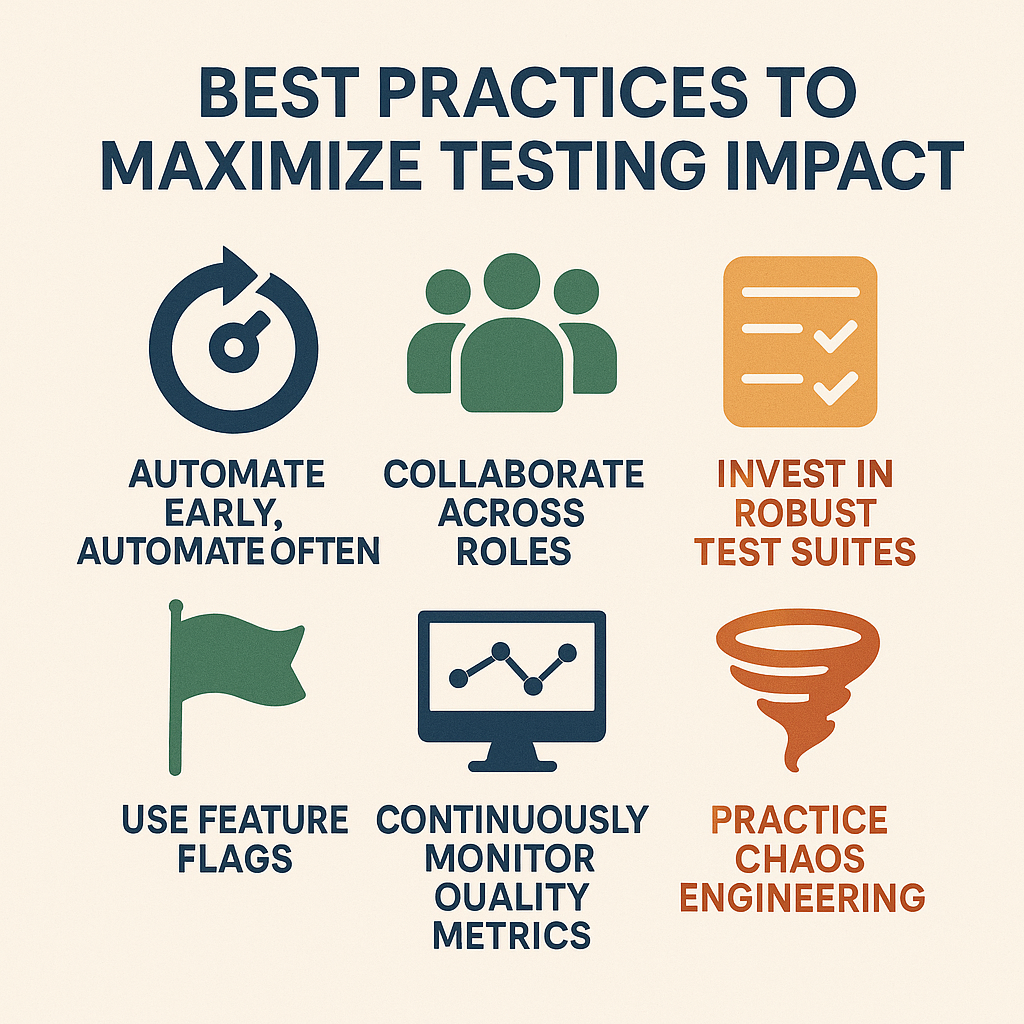
To overcome these challenges and fully leverage Agile and DevOps testing, teams should adopt the following best practices:
- Automate Early, Automate Often: Integrate automation as early as possible in the development cycle to catch issues sooner and speed up feedback loops.
- Collaborate Across Roles: Foster close cooperation between QA, developers, operations, and product teams to ensure alignment on quality goals and testing priorities.
- Invest in Robust Test Suites: Build and maintain comprehensive test coverage—from fast, reliable unit tests to thorough end-to-end (E2E) tests—to balance speed with quality.
- Use Feature Flags: Implement feature flags to enable safe deployments and incremental feature rollouts, reducing risk during releases.
- Continuously Monitor Quality Metrics: Track key quality indicators such as test coverage, defect trends, and pipeline performance to identify improvement areas.
- Practice Chaos Engineering: Introduce controlled failures and stress testing to validate system resilience and improve overall reliability.
- Keep Tests Fast and Reliable: Optimize tests for speed and stability to ensure they remain effective without slowing down the delivery process.
12. Conclusion: The Future of Testing is Agile + DevOps
Agile and DevOps aren’t just buzzwords—they represent a fundamental culture shift in how software is built, tested, and delivered. When integrated effectively, they transform testing into a continuous, collaborative, and intelligent process that’s embedded throughout the software development lifecycle (SDLC).
The future of software quality lies in automation, speed, and resilience. By adopting Agile and DevOps principles, teams can streamline workflows, detect issues earlier, and respond rapidly to change—ensuring faster releases and higher customer satisfaction.
Whether you’re a tester, developer, or manager, embracing this shift empowers you to deliver reliable, high-quality software with confidence. The key is not just doing things faster—but doing them smarter.


Have a project in mind? Let's build something great.
Share your ideas or questions and our experts will get back to you shortly.
Unlock Expert Guidance
Need expert IT advice? Our seasoned professionals are here to help you navigate your tech challenges. Schedule a session with us and get personalized solutions tailored to your business needs.

Connect with Us and Let's Build Something Together
We'd love to hear from you! Whether you have questions, need support, or want to discuss a new project, our team is ready to assist. Fill out the form below, and we’ll get back to you as soon as possible.
Prefer a Direct Consultation?
Connect with our team for a 1-on-1 virtual session to discuss your project, understand your needs, and explore the right solution for your business.
What's Next?
- 1Connect with you at a convenient time
- 2Explore your needs, goals, and requirements
- 3Prepare a tailored proposal based on your needs
Why Choose Us
Connect with AITC
Select your inquiry type to route your request to the right department.
Our Office Locations
Operating across 3 key timezone hubs to serve global enterprise clients.